Proven Four Safe Baby Gates for Homes with Dogs
Choosing the best baby gates for homes with dogs can feel a little complicated. After all, you’re not just trying to keep your curious little one out of trouble.
You’re also creating a comfortable home where your four-legged family member can relax, play, and enjoy everyday life.
Perhaps your toddler has recently discovered the joy of crawling after the family dog. Or maybe your energetic Labrador loves following you from room to room, occasionally knocking over anything in the way.
Whatever your situation, keeping babies and dogs safely separated when necessary is an important part of creating a family-friendly home.

Luckily, the best baby gates for homes with dogs can make daily life much easier.
A well-designed baby gate for dogs and babies helps establish boundaries. It gives your pet a quiet retreat and keeps little explorers from wandering into restricted areas.
However, not every pet gate is suitable for young children. Some popular features may create unexpected safety risks.
This guide presents four practical baby gates for households with dogs. They cover large breeds, open-plan living spaces, and staircases. We also review essential safety features, common installation mistakes, and how to help your dog adjust.
We’ll also look at the essential safety features, common installation mistakes, and ways to help your dog adjust to the new arrangement.
The goal? A happier, more organized home where your baby can explore and your dog can enjoy a little well-deserved peace.
- Why Homes With Babies and Dogs Need the Right Safety Gate
- Understanding Baby Gate Safety Standards in 2026
- How to Choose the Best Baby Gates for Homes With Dogs
- Hardware-Mounted vs. Pressure-Mounted Baby Gates
- Best Baby Gates for Homes With Dogs: Our Top Picks
- Best Baby Gates for Dogs and Babies: Comparison Table
- How to Install a Baby Gate Safely in a Home With Dogs
- Helping Your Dog Adjust to a New Baby Gate
- Conclusion: Choosing the Right Baby Gate for Homes with Dogs
- Frequently Asked Questions
Disclosure: As an Amazon Associate, I earn from qualifying purchases. This means I may receive a small commission when you purchase through links in this article, at no additional cost to you.
Why Homes With Babies and Dogs Need the Right Safety Gate
Watching a baby grow up with a family dog is incredibly heartwarming.
From their first curious glances to those adorable moments when your toddler shares a favorite toy. The relationship between children and pets brings joy to a home.
Still, even the gentlest dog needs personal space.
Young children haven’t yet learned how to respect those boundaries.
Moreover, choosing one of the best baby gates for homes with dogs is about more than preventing access to a staircase.
It is also about creating separate areas where everyone can feel comfortable.
Imagine your dog peacefully napping when your enthusiastic toddler decides it’s time for a cuddle. Before you can intervene, little hands are reaching for ears, tails, or fur.
Your dog might get up and walk away, but even a normally patient pet can react defensively when startled, frightened, or uncomfortable.
A properly installed baby gate lets you separate your dog and child during unpredictable moments while still keeping both within sight.
Protecting Your Baby While Respecting Your Dog’s Space
The American Veterinary Medical Association emphasizes that young children should never be left unsupervised with dogs, even familiar family pets.
The organization also recommends teaching children to respect a dog’s space, especially while the animal is eating, sleeping, or caring for puppies. American Veterinary Medical Association+1
Safety gates can also help establish predictable household routines.
For example, you might use a gate to keep your baby away from the dog’s feeding station, separate an excited puppy during mealtimes, or give an older dog a peaceful area that prefers a quieter environment.
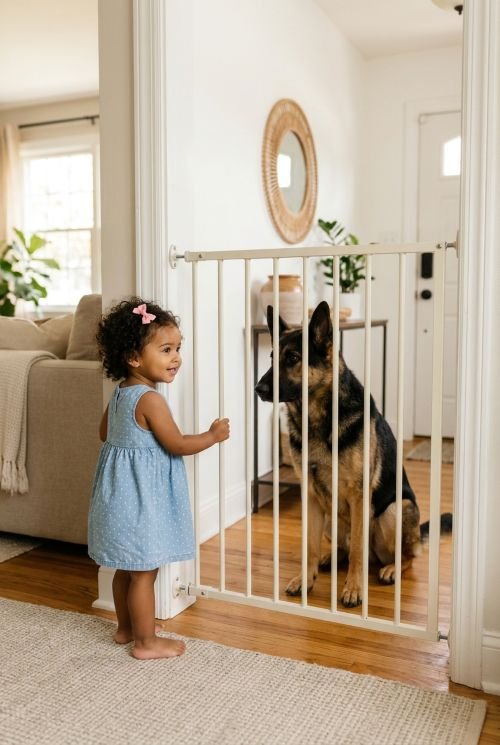
In homes with multiple dogs, strategically positioned gates can make it easier to manage different personalities and energy levels without constantly closing doors.
Of course, a safety gate is only one part of responsible supervision.
Babies can reach through bars, dogs can jump or push against barriers, and an unsecured installed gate may become a hazard itself.
Nevertheless, with proper supervision and careful placement, baby gates for pets and children is one of the most valuable safety tools in your home.
Understanding Baby Gate Safety Standards in 2026
Before comparing baby gates, every parent should understand an important distinction: a product advertised as a pet gate isn’t automatically suitable as a baby safety gate.
For example, a gate designed only to keep a dog in the kitchen may not give the same protection against climbing, entrapment, or accidental opening that a child safety gate is designed to offer.
In the United States, children’s expansion gates and expandable enclosures are regulated under 16 CFR Part 1239. As of November 2026, the applicable regulation incorporates the updated ASTM F1004-25 safety standard.
This standard addresses potential hazards associated with gates intended to restrict young children’s movement, including structural performance, openings, and locking mechanisms.
One particularly important change for families with pets concerns small doors built into baby gates. The updated standard prohibits features or openings that let pets enter or exit a child safety gate independently. According to the Consumer Product Safety Commission, these openings can allow children to escape or become entrapped, potentially resulting in serious injuries.
That means parents should be especially cautious about products marketed as baby gates with dog doors. While a small pet door may seem convenient for letting a cat or small dog get through while keeping a toddler contained, the feature can compromise the purpose of the child safety barrier.
Some gates labeled for pets with small doors may be marketed for containment, but parents must not assume they offer child safety.
When shopping, look for a gate explicitly intended for babies or toddlers, read its current certification information, and follow the manufacturer’s age and installation requirements.
Ideally, choose a model that also meets your dog’s size and behavior needs without introducing openings that could compromise child protection.
Because product specifications and certifications can change, verify the exact model rather than relying on the brand’s reputation alone.
How to Choose the Best Baby Gates for Homes With Dogs
Finding the perfect gate requires considering two very different personalities: your adventurous child and your equally curious dog.
A lightweight gate may be perfectly adequate for separating a calm miniature poodle from a hallway. However, it may struggle when confronted with an energetic German Shepherd.
Similarly, an extra-tall dog barrier might seem reassuring until you discover that its latch, mounting system, or spacing isn’t appropriate for a crawling baby.
Consider Your Dog’s Size, Strength, and Temperament
Start by considering your dog’s size, strength, and temperament. Does your dog calmly accept boundaries, or does it jump against doors when excited?
Is it a determined chewer, a talented jumper, or a small breed that can squeeze through surprisingly narrow spaces?
These details will help you decide whether you need durable metal construction, additional height, or a stronger wall-mounted installation.
However, the gate must meet child safety requirements first, even if that means choosing a separate pet-management solution for particular situations.
Choose the Right Size and Opening Mechanism
Next, measure the area where you plan to install the barrier.
Standard doorways are relatively straightforward, but wide hallways, open-plan living areas, and unusual wall angles can make installation more challenging.
Measure the width at the locations as the manufacturer specified. Check that the mounting surfaces are suitable, and remember that extension panels can have their own limitations.
Never assume a gate will accommodate every width between its advertised minimum and maximum without checking the exact configuration.
Daily convenience matters as well. If you regularly carry laundry, baby supplies, or shopping bags between rooms, a walk-through gate with an easy-to-operate adult latch can make a considerable difference.
An automatic-closing feature may also help in a busy household, although it’s essential to check that the latch has fully engaged rather than relying on the sound of the door closing.
Match the Baby Gate to Your Home’s Layout
Finally, think about your home’s layout and how your family uses each room.
A permanent metal gate may be ideal for a staircase, while a configurable panel system may provide greater flexibility in a large living room.
The best baby gate for a home with dogs fits securely, suits the child’s developmental stage, accommodates your dog’s behavior, and remains practical enough that everyone uses it correctly every day.
Hardware-Mounted vs. Pressure-Mounted Baby Gates
One of the most important decisions you’ll make is whether to choose a hardware-mounted or pressure-mounted baby gate.
Both types can be useful, but they aren’t interchangeable, particularly when staircases, energetic dogs, or uneven installation surfaces are involved.
Understanding how each system works can prevent you from choosing a gate that looks convenient but isn’t suitable for its intended location.
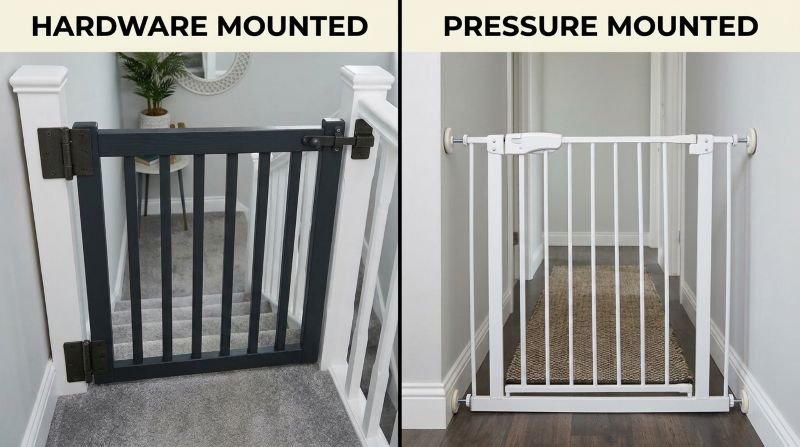
Hardware-Mounted Baby Gates: Strong and Secure
Hardware-mounted baby gates attach to solid, appropriate mounting surfaces using screws and brackets. Hardware provides a fixed connection.
These gates are generally preferable for stairs and places where a secure installation is important. They are also worth considering if you have a large dog that tends to lean against barriers.
Many hardware-mounted models have no bottom crossbar across the walking opening, which can help reduce tripping hazards.
Pressure-Mounted Baby Gates: Convenient for Doorways
Pressure-mounted baby gates, on the other hand, rely on adjustable pressure to hold the gate between two suitable surfaces.
These gates fit doorways and level-floor locations. They often require less drilling. However, some models still need screwed-in wall cups. These gates often have a lower threshold bar that remains in place when the door opens.
That feature can be inconvenient in busy hallways and makes many pressure-mounted designs inappropriate for the top of stairs.
Which Type Is Better for Homes With Dogs?
For households with dogs, the dog’s behavior deserves particular attention.
An excited dog that repeatedly jumps against a pressure-mounted gate may loosen it. This risk increases when the installation is incorrect, or the supporting surfaces are unsuitable.
A quiet, well-trained dog may place far less strain on the same barrier. However, you should not rely on temperament alone to compensate for weak mounting.
For the top of stairs, choose a hardware-mounted gate specifically approved by its manufacturer for that location.
For a hallway on level ground, either mounting style may be suitable when the product’s instructions allow it.
If your dog is exceptionally powerful or persistent, consider a separate secure dog enclosure.
Best Baby Gates for Homes With Dogs: Our Top Picks
Not all baby gates work equally well in pet-friendly homes. Some excel at separating large open spaces, while others are better suited to narrow hallways or staircases.
The following four options stand out. Manufacturers identify them as suitable for children and pets. They are worth considering for dual-use barriers.
These recommendations are based on manufacturer specifications, intended uses, and documented safety features rather than independent hands-on testing.
Product availability and installation requirements may change, so check the exact model and current safety documentation before purchasing.
1. Regalo 2-in-1 Super Wide Safety Gate & Play Yard
Best for Large Open Spaces
If you have an open-plan living room, the kitchen, dining area, and family space flow together. Therefore, you know how hard it is to create boundaries without rearranging your furniture.
This is where the Regalo 2-in-1 Super Wide Safety Gate & Play Yard becomes particularly useful.
Unlike traditional doorway gates, this configurable system uses eight 24-inch metal panels. Additionally, they can create a barrier spanning openings up to 192 inches, or about 16 feet.
Its biggest advantage is flexibility. You can use it as a wall-mounted safety gate across a large opening or arrange the panels into a play-yard configuration according to the manufacturer’s instructions.

This makes it an appealing choice for families who need to separate a baby from the dog’s feeding area, create a temporary child-friendly zone, or prevent access to parts of a large living space.
The manufacturer states that the product targets children aged 6–24 months and suits use with medium to large dogs. Regalo Baby
The gate stands 28 inches tall and includes a walk-through door, allowing adults to move between spaces without dismantling the barrier.
Its metal construction is practical for pets that might chew wooden or plastic barriers, while the configurable panels offer more versatility than a traditional straight gate.
There are a few considerations, though. Because the system contains several hinged sections, it’s essential to follow the installation instructions carefully and use the required hardware when configuring it as a safety gate.
The 28-inch height may also be unsuitable for athletic dogs that can easily jump over barriers.
Don’t use it as an unsupervised substitute for child supervision or to protect against aggressive or forceful dogs.
What we like: Its generous width, durable metal construction, and flexible configurations make it especially practical for large family homes.
What to consider: It requires enough space for the panels and isn’t ideal for determined jumpers or dogs that repeatedly throw their weight against barriers.
2. Cardinal Gates Stairway Special Safety Gate
Best for Staircases and Angled Openings
Staircases deserve special attention in any home with a crawling baby or toddler, but they can become even more challenging when a dog is part of the family.
Perhaps your dog races upstairs whenever the doorbell rings, or your toddler has recently discovered that climbing steps is a wonderful new adventure. In either case, a secure, purpose-designed stairway gate is essential.
Cardinal Gates designed the Stairway Special Safety Gate, model SS-30, for families who need a sturdy barrier for children and pets.
Unlike gates that rely solely on pressure against the walls, this model uses a hardware-mounted installation for stability. It also includes an adult-operated latch designed to be difficult for toddlers to open independently.
One feature, particularly useful, is its ability to accommodate angled installations of up to 30 degrees, according to Cardinal Gates. This can be helpful in homes where the staircase doesn’t have perfectly aligned mounting surfaces.
The gate is also certified by the Juvenile Products Manufacturers Association (JPMA), now known as the Baby Safety Alliance. Cardinal Gates
For dog owners, the metal construction is another attractive feature.
A gate that can withstand everyday wear, occasional contact with pets, and regular use is preferable to a lightweight temporary barrier.
However, if your dog has a habit of jumping against gates, you’ll still need to manage that behavior rather than relying entirely on the strength of the installation.
The most important consideration is correct mounting. Stairway gates must be attached to suitable, secure supports, and the instructions for the exact installation location should always take priority.
The SS-30 also has specific hardware and placement requirements that should be reviewed before purchase.
What we like: Dedicated stairway design, secure wall mounting, and flexibility for certain angled openings.
What to consider: Requires drilling and careful installation. It may not suit every banister or unusual staircase without appropriate manufacturer-approved hardware.
3. Babelio Removable No Bottom Bar Baby Gate for Stairs
Best for Busy Households With Dogs
If you have a busy household with a curious toddler and an energetic dog, you’ll appreciate a baby gate that makes moving between rooms easy without compromising safety.
The Babelio Removable No Bottom Bar Baby Gate for Stairs combines a sturdy metal design with convenient everyday features, making it a practical choice for families juggling little feet and furry paws.
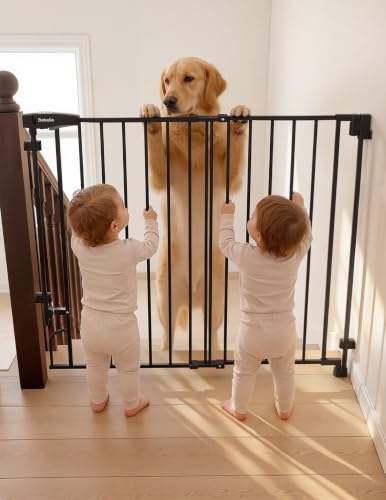
Unlike traditional pressure-mounted gates, this model uses a hardware-mounted installation, providing a secure barrier for stairways, doorways, and other suitable openings.
Its standout feature, however, is the absence of a bottom bar, which creates a clear walking path when the gate is open.
That’s especially helpful when you’re carrying your baby, walking through with groceries, or trying to avoid tripping over a threshold while your dog follows close behind.
Designed for Safety and Everyday Convenience
The Babelio gate is made with durable steel and features a double-locking mechanism designed to prevent young children from opening it on their own.
It also includes an automatic-closing function, which can be particularly convenient when you have your hands full.
Another useful feature is its removable design. When you no longer need the barrier temporarily, you can detach the gate panel while leaving the mounting hardware in place.
Why This Baby Gate Works Well for Homes With Dogs
For dog owners, the steel construction is a welcome advantage, particularly if your pet occasionally scratches or paws at barriers.
The no-bottom-bar design also allows your dog to walk through comfortably whenever you open the gate, without stepping over a raised threshold.
However, remember that even a sturdy metal baby gate isn’t designed to withstand unlimited force.
If your dog repeatedly jumps against barriers or tries to escape, additional training and a separate secure containment area may be necessary.
Because this gate requires drilling, you’ll also need suitable mounting surfaces. Follow the instructions for your exact model, particularly when installing it near stairs, and always verify that the automatic latch has fully engaged.
What we like: Sturdy steel construction, no bottom threshold, automatic closing, double-locking mechanism, and removable gate panel.
What to consider: Requires drilling, careful alignment, and secure mounting. A determined jumper may need a taller or dedicated pet containment solution.
View Babelio Removable Baby Gate on Amazon
4. BabyDan Flex XL Safety Gate
Best for Flexible Room Dividers
For families who need a baby gate that adapts to changing circumstances, the BabyDan Flex XL Safety Gate is another option worth exploring.
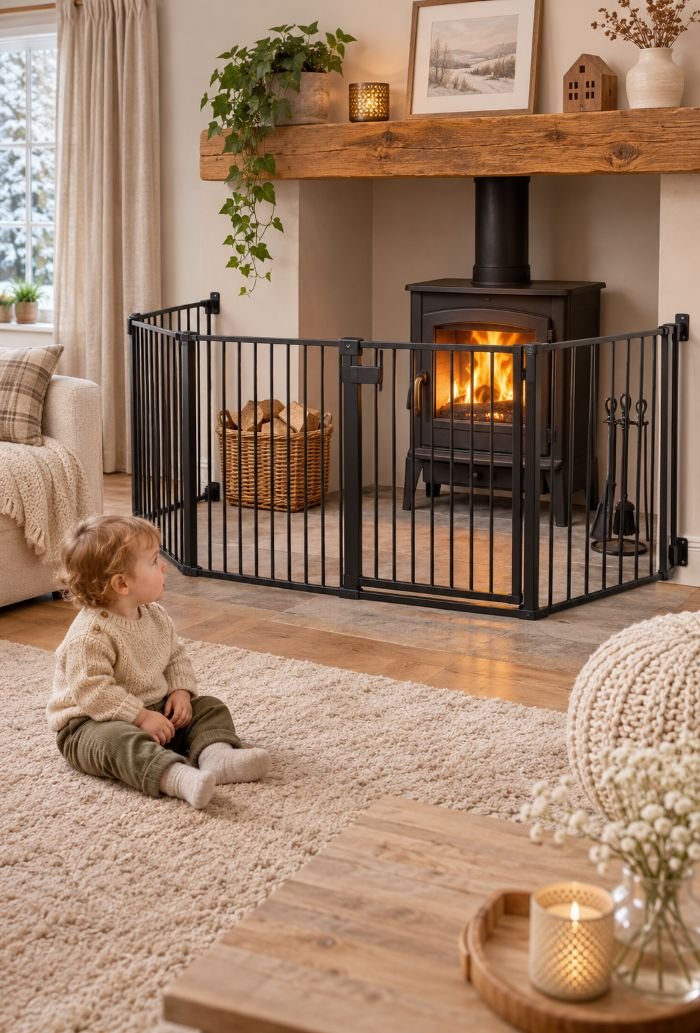
This versatile system works as a wall-mounted room divider or hearth barrier, making it especially useful in homes with unusually shaped spaces or areas that need extra protection.
According to BabyDan, the Flex XL stands approximately 70.5 cm tall and accommodates installations ranging from 90 to 278 cm, depending on the configuration.
Its powder-coated steel construction provides a durable barrier, and its multiple sections let families arrange the gate around appropriate areas rather than being restricted to a single straight opening.
Imagine having a large living room with your dog’s bed in one corner and a fireplace on the opposite side. A flexible barrier can help create boundaries around areas where your toddler shouldn’t have unrestricted access.
It can also separate your baby’s play area and a section of the home where your dog prefers to rest.
However, there is one important distinction. Although you can configure the Flex XL for hearth protection, families must follow BabyDan’s instructions for required distances from heating appliances and other hazards.
Never place a gate so close to a fireplace or wood stove that its components become overheated or fail to provide the required clearance.
When buying, ensure you choose the correct BabyDan model for your location and intended use. Product ranges and regional versions can differ, and verify the applicable child safety certification before installation.
What we like: Flexible layout, metal construction, and suitability for creating larger designated zones.
What to consider: More involved installation than a simple doorway gate, and placement around heating appliances requires particular care.
View BabyDan Flex XL Safety Gate on Amazon.
Best Baby Gates for Dogs and Babies: Comparison Table
To make your decision easier, here’s how the four recommended gates compare based on their published manufacturer specifications.
| Baby gate | Height | Maximum advertised width | Best for |
|---|---|---|---|
| Regalo 2-in-1 Super Wide | 28 in | 192 in | Open-plan rooms and large spaces |
| Cardinal Gates Stairway Special SS-30 | Check current model dimensions | 42.5 in in installation manual | Staircases and angled openings |
| Babelio Removable No Bottom Bar Baby Gate for Stairs | 34 in | 41 in | Everyday stairway access |
| BabyDan Flex XL | 27.76 in | 109.45 in | Flexible room dividers |
The Regalo model offers the widest coverage of the four options, making it attractive for households with large spaces that need separating.
Meanwhile, Cardinal Gates and Babelio are especially useful for securing stairways. BabyDan provides another adaptable solution for creating defined areas within a room.
However, the advertised width of a safety gate shouldn’t be the only factor influencing your choice.
Pay just as much attention to the required mounting system, your child’s age and abilities, and whether your dog is likely to jump, chew, push, or climb against the barrier.
Remember that no baby gate is guaranteed to contain every dog. An athletic or determined pet may be able to defeat a barrier that works perfectly well for a calmer animal.
In those situations, training, supervision, and a more suitable separate containment arrangement are essential.
How to Install a Baby Gate Safely in a Home With Dogs
Even the most carefully chosen baby gate can become unsafe if you don’t install it correctly.
Unfortunately, it’s easy to underestimate the importance of small details such as uneven surfaces, incorrectly positioned brackets, or missing mounting hardware.
In a household with dogs, the gate may experience additional pressure from curious noses, enthusiastic paws, or pets leaning against the bars.
Measure the Opening and Secure the Mounting Hardware
Begin by measuring the intended opening carefully and reviewing the manufacturer’s instructions before assembling anything.
A gate that is too narrow, stretched beyond its approved dimensions, or installed with incompatible extensions may not provide adequate protection.
Likewise, mounting brackets must be attached to suitable surfaces rather than relying on weak trim, loose plasterboard, or furniture that could move.
Check for Gaps, Loose Fittings, and Other Hazards
Once installed, check the barrier from both sides.
The gate should remain stable, the locking mechanism should engage securely, and there shouldn’t be any gaps that could allow your baby to crawl underneath or become trapped.
Make sure your dog cannot squeeze through the bars or get its head stuck between the gate and surrounding structures.
For homes with larger dogs, pay particular attention to areas where the gate might experience repeated contact.
A dog that charges toward the front door whenever someone arrives, for example, may place significant force on a nearby barrier.
If that behavior is common, consider moving the gate to a quieter location and establishing a separate secure area for your pet.
Inspect Your Baby Gate Regularly
Also make gate inspections part of your regular household routine.
Check for loose fittings, damaged components, weakening hinges, and latches that no longer close properly. Stop using the gate immediately if you notice damage or instability.
Most importantly, never install a pressure-mounted gate at the top of stairs unless the specific product is explicitly approved for that installation, and follow the manufacturer’s restrictions.
Choosing a gate specifically designed and hardware-mounted for top-of-stairs use is the safer approach.
Helping Your Dog Adjust to a New Baby Gate
Once you’ve installed your baby gate, you might assume the difficult part is over. But what happens if your dog starts barking, whining, or scratching at the barrier?
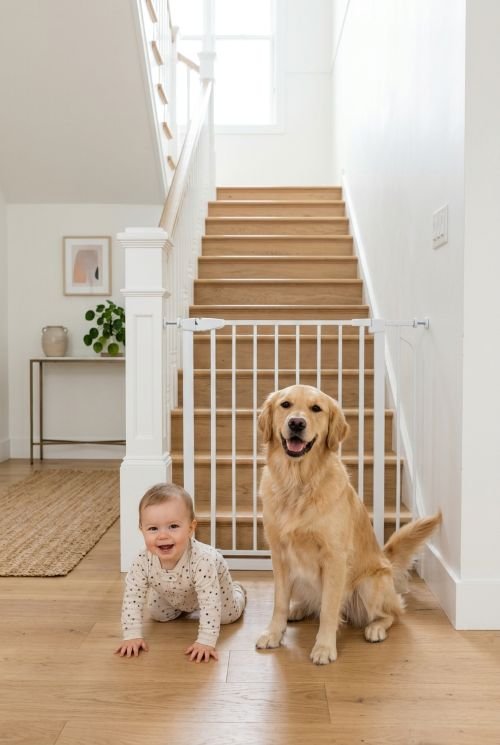
For some pets, suddenly being unable to follow family members into their favorite rooms can be confusing or frustrating.
This is especially true for dogs that have always enjoyed unrestricted access around the house.
Introduce the Baby Gate Gradually
Fortunately, you can make the transition easier by introducing the new boundaries gradually.
Instead of closing the gate immediately and leaving your dog separated for a long period, begin with short, positive experiences.
Let your pet explore the new gate while it’s safely managed, reward calm behavior, and make sure the area behind the barrier has something comfortable, such as a familiar bed or favorite chew toy.
Use Positive Reinforcement to Encourage Calm Behavior
You might start by encouraging your dog to settle in its designated space while you’re nearby.
Offer a suitable treat or enrichment toy, close the gate briefly, and reward relaxed behavior. Over time, gradually increase the duration, provided your dog remains comfortable.
If your pet becomes distressed, starts pawing aggressively at the gate, or repeatedly attempts to escape, reduce the difficulty and seek advice from a qualified reward-based dog trainer or veterinary behavior professional if needed.
Creating a positive association with the gate is important because the barrier shouldn’t feel like punishment.
Ideally, your dog will begin recognizing its designated area as a peaceful place where it can relax without being interrupted by an energetic toddler.
Teach Your Toddler to Respect Your Dog’s Boundaries
At the same time, teach your child to respect the dog’s boundaries as they grow. Explain that the dog’s bed, food, and toys aren’t for grabbing, and discourage reaching through the gate or trying to climb over it.
The American Academy of Pediatrics advises parents never to leave young children alone with animals and to teach them not to disturb pets while sleeping or eating.
Remember, the goal isn’t to keep your dog and baby separated forever. It’s to create safe, manageable opportunities for interaction while giving both the freedom to enjoy their own space.
When you introduce boundaries patiently and consistently, baby gates will help maintain harmony in your family home.
Conclusion: Choosing the Right Baby Gate for Homes with Dogs
Finding the best baby gates for homes with dogs doesn’t have to be overwhelming.
The secret is choosing a barrier that meets your child’s safety needs while also accommodating your dog’s size, personality, and everyday habits.
Whether you need to secure a staircase, separate a spacious living room, or create a relaxing retreat for your pet, practical options to suit different family homes are available.
However, remember that a gate isn’t a replacement for supervision, dog training, or an appropriate childproofing routine.
Even the most reliable barrier needs to be installed correctly, checked regularly, and used according to the manufacturer’s instructions.
Above all, think of your baby gate as a way to make everyday family life more comfortable.
Your baby gets a safer space to explore, your dog enjoys a little breathing room, and you get a more practical way to manage a busy household.
And really, isn’t that what every parent wants?
A home where little feet and furry paws can happily coexist, with sensible boundaries helping everyone feel more secure.
Frequently Asked Questions
1. Can You Use a Dog Gate as a Baby Gate?
Not necessarily. Although dog gates and baby gates often look similar, they may have different intended uses, safety features, and testing requirements. A pet-only gate might be designed to contain an animal without addressing important child safety concerns such as climbing hazards, head entrapment, or the strength of the locking mechanism.
If you need a barrier to protect your baby or toddler, choose a product explicitly designed and certified for child safety. In the United States, children’s safety gates must comply with the applicable federal requirements under 16 CFR Part 1239. A gate intended solely for pets should not be treated as a substitute for a compliant baby gate.
2. What Is the Best Baby Gate for Large Dogs?
For large dogs, prioritize strong construction, secure mounting, an appropriate height, and a gate that is also certified for child use. Hardware-mounted metal gates are often worth considering because they attach securely to suitable supporting surfaces. Models such as the Cardinal Gates Stairway Special or Regalo 2-in-1 Super Wide Safety Gate may suit certain households, depending on the opening and the dog’s behavior.
However, no baby gate is guaranteed to contain a large, powerful, or determined dog. If your pet regularly jumps over barriers or repeatedly charges against them, a dedicated dog-safe room, properly designed enclosure, or additional training may be necessary.
3. Are Baby Gates With Pet Doors Safe for Toddlers?
Baby gates with small pet doors are not recommended for toddler containment. The updated ASTM F1004-25 standard, incorporated into U.S. federal requirements in 2026, specifically prohibits features that allow pets to pass independently through a child safety gate.
These openings can create potential escape and entrapment hazards for young children. Although some pet-only gates still feature small doors for cats or dogs, those products should not be assumed suitable for keeping babies safely contained.
4. Can Dogs Knock Down Pressure-Mounted Baby Gates?
Yes. A dog may be able to dislodge a pressure-mounted gate, particularly if the animal repeatedly jumps against it, leans heavily on the barrier, or the gate hasn’t been installed according to the manufacturer’s instructions. The risk may be greater when mounting surfaces are unsuitable or required wall cups haven’t been secured correctly.
If your dog frequently pushes against gates, consider a properly installed hardware-mounted model intended for children and appropriate for the location. However, it’s equally important to address the behavior that’s causing the dog to challenge the barrier.
5. How Tall Should a Baby Gate Be for a Home With Dogs?
Many standard baby gates are approximately 28–32 inches tall, but the most suitable height depends on your child’s developmental abilities and your dog’s size and behavior. A calm, small dog may be comfortably managed by a standard-height gate, while a larger or athletic dog could jump over the same barrier.
Instead of choosing the tallest available pet gate, prioritize a child-certified model that meets your baby’s needs. Remember, a taller gate isn’t automatically safer for toddlers, especially if its design introduces footholds or other climbing opportunities.
Most importantly, stop using a child safety gate when your child can climb over or dislodge it, or when the manufacturer’s age, height, or developmental limits have been reached.