
7 Best Baby Gates for the Bottom of Stairs: Smart & Affordable Safety Picks
Trying to find one of the best baby gates for the bottom of stairs is an important part of creating a safer home for your growing little explorer.
Watching your little one learn to crawl, stand, and take those first wobbly steps is such an exciting milestone. But as your baby becomes more adventurous, everyday places around your home can suddenly turn into potential hazards.
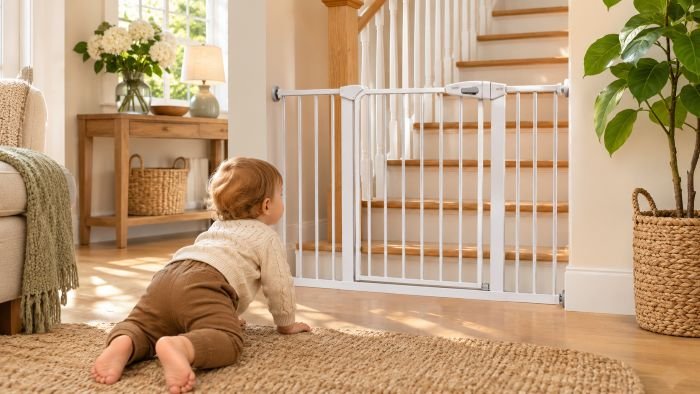
To a curious toddler, those steps may look like a wonderful new playground just waiting to be explored. Unfortunately, babies don’t yet understand how easily they can lose their balance or how dangerous a fall can be.
But here’s some good news.
You don’t necessarily need an expensive, heavy-duty, hardware-mounted gate for the bottom of your staircase.
Affordable Baby Gates for the Bottom of Stairs: More Options Than You Think
Top-of-stairs gates must be securely mounted with hardware, but bottom-of-stairs gates have a different role: they stop your child from climbing the stairs without supervision.
This means you have more options to choose from!
For example, certain pressure-mounted baby gates offer an affordable and convenient solution, while retractable mesh gates can be ideal if you want something that takes up less space.
Of course, not every baby gate is suitable for every staircase. The right choice depends on your home’s layout, your child’s developmental stage, and the manufacturer’s installation requirements.
Let’s look at seven practical baby gates, including budget-friendly pressure-mounted models, retractable designs, and more versatile designs.
You’ll also learn what features to look for, where to put your gate, and how to avoid common mistakes. mistakes.
Let’s find the right gate for your family!
This post may contain affiliate links. This means I get a commission if you purchase through my links at no extra cost. Read the full disclosure here.
Do You Need a Special Baby Gate for the Bottom of Stairs?
As you begin researching baby gates, you’ll see that certain products are marketed for stairways, whereas others are marketed for doorways and hallways.
This can be confusing, especially when two gates look almost identical.
Understanding that safety requirements differ for the top and bottom of stairs is key.
Why the Bottom of Stairs Is Different From the Top
Placing a baby gate at the top of a staircase prevents a child from falling down the steps.
Because of this serious risk, the U.S. Consumer Product Safety Commission (CPSC) recommends using only gates that screw securely into the wall at the top of stairs.
People describe these hardware-mounted baby gates.
At the bottom of stairs, however, the main concern is usually preventing your little one from starting to climb.
And this is where your choice becomes more flexible.
A suitable pressure-mounted gate can block access to the staircase without the permanent mounting required by a traditional hardware-mounted model.
Some manufacturers design and test retractable baby gates specifically for bottom-of-stairs installations.
However, you must secure the gate properly, ensure it suits the location, and install it according to the manufacturer’s instructions.
Can You Use a Pressure-Mounted Baby Gate at the Bottom of Stairs?
Yes! Manufacturers make pressure-mounted baby gates designed for bottom-of-stair use.
Rather than relying entirely on screws and permanent wall brackets, these gates use adjustable tension to hold the barrier between two suitable surfaces.
This makes them particularly appealing to parents who want something affordable, practical, and relatively easy to install.
However, keep one important detail in mind.
You may need to screw wall cups into the mounting surfaces to secure some pressure-mounted gates. These components help prevent the gate from being pushed out of position.
Therefore, a pressure-mounted gate isn’t always completely drill-free.
What About Retractable Baby Gates?
Retractable baby gates are another option worth considering.
Instead of having a traditional swinging metal door, they feature a mesh barrier that rolls back into a compact housing when opened.
This can be especially convenient in smaller homes, narrow hallways, or areas where a conventional swinging gate would get in the way.
However, most child-rated retractable gates require secure hardware mounting.
The advantage is their space-saving design, not necessarily a no-drill installation.
Like pressure-mounted gates, only use a retractable gate at the bottom of stairs when the manufacturer specifically approves that placement.
7 Best Baby Gates for the Bottom of Stairs
With so many baby gates available, finding the right one can feel overwhelming.
Some models are wonderfully convenient but may not fit wider openings. Others add additional features that aren’t necessarily worth paying extra for.
To make your decision easier, we’ve selected seven gates covering different budgets, installation preferences, and staircase layouts.
Quick Comparison: Best Baby Gates for the Bottom of Stairs
| Baby gate | Best for | Installation |
|---|---|---|
| Safety 1st Pressure Mounted Baby Gates for Doorways with SecureTech | Best overall | Pressure-mounted |
| Safety 1st Easy Install Walk-Through Baby Gate | Everyday convenience | Pressure-mounted with required wall cups |
| Safety 1st Lift, Lock & Swing Dual-Mode | Versatile installation | Pressure or hardware |
| Regalo Easy Step Extra Tall | Families wanting a taller gate | Pressure-mounted with required wall cups |
| Retract-A-Gate | Best retractable design | Hardware-mounted |
| Toddleroo Retractable Fit Mesh Gate | Compact storage and wide openings | Hardware-mounted |
| Cardinal Gates Stairway Special | Angled or unusual staircases | Hardware-mounted |
These recommendations are based on published product features and installation guidance, not independent hands-on testing. Always confirm the current instructions for your exact model.
1. Safety 1st Pressure-Check Baby Gate with SecureTech — Best Overall
Best for: Parents who want an affordable, easy-to-use pressure-mounted gate with helpful safety indicators.
If you want a practical baby gate that doesn’t require complicated installation, the Safety 1st Pressure-Check with SecureTech deserves a closer look.

One of its most appealing features is the SecureTech visual indicator system. These red-to-green indicators show whether the gate is properly latched and correctly pressurized.
This is especially useful because a pressure-mounted gate may look secure even when it hasn’t been adjusted correctly.
The gate features a one-hand opening mechanism, which is convenient when you’re carrying laundry, toys, or other everyday essentials.
It also doesn’t require additional drilling hardware when installed according to the manufacturer’s approved configuration.
Key Features
- Pressure-mounted installation.
- SecureTech visual pressure and lock indicators.
- One-handed opening.
- Fits openings approximately 29–38 inches wide.
- Stands 28 inches high.
- Manufacturer-approved for use at the bottom of stairs.
- JPMA certified.
What We Like
The visual indicators are particularly helpful for parents who want reassurance that the gate is properly secured.
Its adjustable width also suits many standard stairway entrances.
Furthermore, the straightforward design makes everyday use relatively simple.
Things to Consider
The pressure-mounted frame includes a bottom bar, which may create a tripping hazard.
You’ll also need two suitable mounting surfaces and must follow the manufacturer’s precise installation instructions.
Never pressure-mount this model at the top of stairs.
Our verdict: An appealing all-around option for parents who want a straightforward pressure-mounted gate without unnecessary extras.
View the Safety 1st Pressure Mounted Baby Gates for Doorways with SecureTech
2. Safety 1st Easy Install Walk-Through Baby Gate — Best for Everyday Convenience
Best for: Busy families who frequently walk between the staircase and adjoining rooms.
If you’re constantly moving around the house, opening and closing a baby gate dozens of times a day can quickly become frustrating.
That’s where a walk-through design comes in handy.
The Safety 1st Easy Install Walk-Through Baby Gate features a swinging door that allows adults to pass through without removing the entire barrier.

It also includes the manufacturer’s SecureTech indicator, which changes color to confirm that the gate is securely locked.
Another convenient feature is its dual-action, one-handed opening mechanism.
This makes it easier to operate while you manage everyday household activities.
Key Features
- Pressure-mounted installation.
- Swing-open walk-through door.
- SecureTech locking indicator.
- One-handed, dual-action opening.
- Approximately 28 inches high.
- Adjustable to fit openings up to 38 inches using the included extensions.
- Includes four required wall cups.
- Approved for bottom-of-stairs use.
What We Like
The walk-through design is the biggest advantage.
Instead of lifting a barrier out of position, you simply open the door, walk through, and close it securely behind you.
This makes it particularly convenient for staircases that adults use frequently.
The visual locking indicator is another welcome feature.
Things to Consider
The manufacturer requires the supplied wall cups to keep the gate securely in place.
As a result, installation may involve drilling, depending on the mounting arrangement.
The bottom threshold is another potential drawback, particularly in busy walkways.
Our verdict: A good choice for families who value everyday convenience and want a pressure-mounted gate with a dedicated walk-through door.
View the Safety 1st Easy Install Walk-Through Gate
3. Safety 1st Lift, Lock & Swing Dual-Mode Gate — Best Versatile Option
Best for: Parents who want one gate that has different installation possibilities.
Not every family needs a baby gate permanently installed in one location.
Maybe you’re planning to rearrange your rooms, or you want something that can be used in a doorway now and another appropriate location later.
The Safety 1st Lift, Lock & Swing Dual-Mode Gate offers that flexibility.

Unlike many conventional baby gates, this model can be installed using either pressure mounting or hardware mounting.
However, the gate operates differently depending on the installation mode.
When pressure-mounted, the gate uses a lift-to-release design that allows you to remove the barrier from the opening.
When hardware-mounted, it can function as a swing-open gate. This makes it worth considering for households with changing needs.
Key Features
- Dual-mode pressure or hardware installation.
- Adjustable width of approximately 28–42 inches in pressure mode.
- Hardware mode fits openings approximately 30–42 inches.
- Stands approximately 26 inches high.
- One-handed lift-to-release operation.
- Swing-open operation when hardware-mounted.
- Suitable for bottom-of-stairs installations in approved configurations.
What We Like
The flexibility is the main attraction.
Instead of purchasing separate gates for different areas, you can choose the installation mode that suits your needs.
Its removable design may also be helpful when you temporarily need a clear passageway.
Things to Consider
The pressure-mounted version isn’t a conventional walk-through gate. You’ll need to lift the barrier out of place.
This may be less convenient if you use the staircase frequently.
Additionally, only install the gate at the top of the stairs in the manufacturer’s approved hardware-mounted configuration.
Our verdict: A practical option for families who value flexibility over a permanent walk-through design.
View the Safety 1st Lift, Lock & Swing Gate
4. Regalo Easy Step Extra Tall Baby Gate — Best Extra-Tall Pressure-Mounted Gate
Best for: Parents who prefer a taller baby gate with a convenient walk-through door.
Some parents feel more comfortable using a taller baby gate, particularly as their toddler grows.
The Regalo Easy Step Extra Tall Safety Gate stands approximately 36 inches high, making it taller than many standard models.

It features a sturdy metal frame, a walk-through door, and a lever-style safety latch.
The pressure-mounted design can make setup straightforward when suitable mounting surfaces are available.
However, Regalo specifically requires the supplied wall cups to keep the gate secure.
Key Features
- Pressure-mounted metal frame.
- Approximately 36 inches high.
- Fits specified openings between 29 and 36.5 inches.
- Walk-through door.
- Lever-style safety latch.
- Includes a compatible extension.
- Wall cups required for secure installation.
- Intended for children approximately 6–24 months.
What We Like
The additional height may appeal to families who prefer a taller barrier.
The walk-through door also makes it more convenient than gates that must be lifted out of the opening.
Additionally, the metal frame is easy to wipe clean.
Things to Consider
Because it’s pressure-mounted, never install this gate at the top of stairs.
The raised bottom bar can also be a tripping hazard.
More importantly, an extra-tall gate isn’t a solution for a child who has learned to climb.
Stop using the gate when your child can climb over or dislodge it, regardless of its height.
Our verdict: A worthwhile option if you want a taller pressure-mounted gate, provided the exact model’s instructions permit your intended bottom-of-stairs installation.
View the Regalo Easy Step Extra Tall Gate
5. Retract-A-Gate Safety Gate — Best Retractable Baby Gate
Best for: Parents who want a space-saving gate that disappears neatly when not in use.
If traditional metal baby gates feel bulky or awkward in your home, a retractable gate may be just what you’re looking for.
When searching for the best baby gates for the bottom of stairs, the Retract-A-Gate is a great option with features like a durable mesh barrier that rolls back into a slim housing when opened.
This means you don’t have a large gate door swinging into your hallway or living area.
It’s especially useful for smaller homes where every bit of floor space matters.
Another advantage is its versatility.
Retract-A-Gate offers models for openings up to 52 or 72 inches wide, making it suitable for many wider stairway entrances.
The manufacturer specifically approves the gate for both top- and bottom-of-stairs use when properly installed.
Key Features
- Retractable mesh design.
- Hardware-mounted installation.
- Models for openings up to 52 or 72 inches.
- Approximately 34-inch-high mesh.
- Compact housing when retracted.
- Child-resistant locking mechanism.
- One-handed operation.
- JPMA-certified for approved stairway installations.
What We Like
The space-saving design is a major advantage.
When you’re not using the barrier, it retracts neatly rather than remaining in the middle of the room.
It also provides a flexible solution for wider openings that may be difficult to cover with standard pressure-mounted gates.
Another benefit is the absence of a permanent metal threshold across the walking area.
Things to Consider
Retract-A-Gate requires hardware mounting, so it isn’t a drill-free option.
It can also cost more than basic pressure-mounted baby gates.
And remember, mesh gates must be properly locked and tensioned according to the manufacturer’s directions.
Our verdict: A strong choice for parents who value a tidy appearance, convenient operation, and flexible sizing.
View the Retract-A-Gate Safety Gate
6. Toddleroo Retractable Fit Mesh Gate — Best Space-Saving Alternative
Best for: Parents who want a retractable baby gate for a wider opening or compact living space.
Another practical option is the Toddleroo by North States Retractable Fit Mesh Gate.

Like Retract-A-Gate, this model uses a retractable mesh panel instead of a traditional swinging metal door.
It can accommodate openings up to approximately 55 inches wide, which may be useful for larger stairway entrances.
The gate also includes mounting brackets that allow it to accommodate certain angled installations.
This is especially helpful when your staircase doesn’t have two perfectly aligned walls.
Another attractive feature is its visual locking indicator, which turns green when the gate is correctly engaged.
Key Features
- Retractable mesh panel.
- Hardware-mounted installation.
- Fits openings up to approximately 55 inches.
- Approximately 33 inches high.
- Visual locking indicator.
- Suitable for bottom-of-stairs use.
- Adjustable mounting arrangement for certain angled openings.
- No fixed threshold across the walkway.
What We Like
This gate combines a space-saving design with flexibility for wider or angled openings.
The visual locking indicator is particularly helpful because it provides a quick way to check whether the gate is properly secured.
It also retracts fully when opened, keeping the passageway clear.
Things to Consider
Despite its lightweight appearance, the gate requires secure hardware mounting.
You’ll also need enough suitable wall or banister surface for the mounting brackets.
Because mesh gates are flexible, correct installation and locking are essential.
Our verdict: An attractive alternative to conventional metal gates, particularly for parents who want a retractable design with versatile mounting possibilities.
View the Toddleroo Retractable Fit Mesh Gate
7. Cardinal Gates Stairway Special Safety Gate — Best for Unusual Staircases
Best for: Staircases with angled walls, banisters, or challenging mounting arrangements.
Although pressure-mounted and retractable gates are often convenient for the bottom of stairs, they aren’t always the best fit.
Some staircases have unusual shapes, uneven mounting surfaces, or banisters that make a conventional gate difficult to install securely.
In these situations, a hardware-mounted option may be worth the additional effort.
The Cardinal Gates Stairway Special Safety Gate is designed for stairway installations and allows mounting at angles of up to 30 degrees.
It features a durable metal construction and a latch designed for one-handed adult operation.
The aluminum model fits openings approximately 27–42.5 inches wide, with compatible extensions available separately.
Key Features
- Secure hardware-mounted installation.
- Adjustable angled mounting.
- Approximately 29.5 inches high.
- Fits openings approximately 27–42.5 inches with the aluminum version.
- One-handed adult latch.
- Optional extensions.
- Available in different finishes.
- JPMA certified.
What We Like
The angled mounting capability is particularly useful for unconventional staircase layouts.
Its durable construction and adjustable design also make it suitable for families who prefer a more permanent installation.
Things to Consider
Installation requires appropriate structural mounting.
Additional accessories may be needed for certain banisters or wider openings.
It also requires more installation work than a basic pressure-mounted gate.
Our verdict: A useful alternative when a standard pressure-mounted or retractable gate isn’t suitable for the shape of your staircase.
View the Cardinal Gates Stairway Special
Watch a detailed tutorial on YouTube; How to install the Cardinal Stairway Gate
Pressure-Mounted vs. Retractable Baby Gates: Which Is Better?
Now that we’ve explored the individual products, you may still be wondering which type of baby gate is the better choice for your home.
For many families, the decision comes down to convenience, installation requirements, available space, and budget.
Let’s compare the two most interesting options for the bottom of stairs.
Pressure-Mounted Baby Gates: Affordable and Practical
Pressure-mounted gates are popular because they’re generally straightforward to install and often cost less than specialized retractable models.
They use adjustable tension to hold the gate against suitable mounting surfaces.
Some models offer a walk-through door, while others must be removed or lifted out of the opening.
Advantages of Pressure-Mounted Gates
- Often more affordable than specialized retractable gates.
- Convenient for standard doorway-sized openings.
- Many include walk-through doors.
- Usually straightforward to adjust.
- Some models don’t require drilling.
- Available in a wide range of heights and styles.
Disadvantages of Pressure-Mounted Gates
- Not suitable for the top of stairs.
- Some require screwed-in wall cups.
- Raised bottom bars can create tripping hazards.
- May not work well with angled walls or unusual banisters.
- Can become insecure if incorrectly installed or adjusted.
Best for: Families with standard staircase openings who want an affordable, convenient gate and can follow the manufacturer’s mounting requirements.
Retractable Baby Gates: Space-Saving and Stylish
Retractable gates are particularly attractive when you want a baby gate that doesn’t dominate your home.
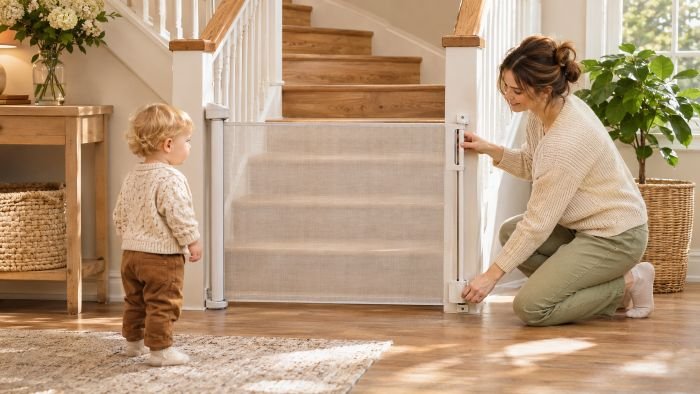
Instead of remaining permanently across the opening, the mesh rolls neatly into its housing.
This makes them useful in narrow hallways and busy living spaces.
Advantages of Retractable Gates
- Space-saving design.
- No swinging metal gate door.
- Often suitable for wider openings.
- Many models have no raised floor threshold.
- Less visually intrusive.
- Some accommodate angled mounting arrangements.
Disadvantages of Retractable Gates
- Usually require hardware mounting.
- May cost more than simple pressure-mounted gates.
- Not all models are approved for stairway use.
- Must be correctly extended, secured, and locked.
- Some are less convenient to operate while carrying items.
Best for: Parents who want a less noticeable gate, especially in smaller homes or wider openings.
Quick Comparison
| Feature | Pressure-mounted | Retractable |
|---|---|---|
| Typical cost | Often lower | Often higher |
| Drill-free options | Some models | Uncommon for child-rated gates |
| Space-saving | Moderate | Excellent |
| Walk-through convenience | Often excellent | Depends on design |
| Wide openings | Model dependent | Often suitable |
| Raised threshold | Common | Usually absent |
| Bottom-of-stairs use | Approved models only | Approved models only |
Which Would We Choose?
For a typical staircase with two suitable mounting surfaces, an approved pressure-mounted gate can be a sensible and budget-friendly choice.
However, if your staircase opens directly into a small living room or narrow hallway, a retractable design may be more convenient.
And if your staircase has unusual banisters or angled walls, a compatible hardware-mounted gate may provide the better solution.
Ultimately, the best choice isn’t necessarily the most expensive or stylish model.
It’s the one that fits your staircase correctly and can be installed safely.
How to Choose the Best Baby Gate for the Bottom of Stairs
Before adding a baby gate to your shopping cart, take a few minutes to think about your home’s layout.
A gate that works beautifully in one family’s home may be completely unsuitable for another.
Here are the most important features to consider.
1. Measure Your Staircase Opening Carefully
Start by measuring the width of the opening where you intend to install the gate.
Don’t assume that your staircase has a standard doorway width.
Some staircases are much wider, while others have skirting boards, decorative posts, or uneven walls that affect the available space.
Follow the manufacturer’s measuring instructions, including any required measurements at different heights.
Also, check whether extensions are available and whether they’re approved for your chosen model.
Never improvise with extensions from another brand.
2. Decide Whether You Want to Drill
If you own your home, a few small mounting holes may not be a major concern.
However, if you’re renting, you may prefer a gate that can be installed with minimal permanent changes.
Certain pressure-mounted gates are designed for no-drill installation.
Nevertheless, others require wall cups secured with screws.
Always distinguish between a gate advertised as pressure-mounted and one that is genuinely approved for no-drill installation in your intended location.
3. Look for an Easy-to-Use Lock
A baby gate that is difficult to operate can quickly become frustrating.
And let’s face it, when you’re carrying a basket of laundry or managing a busy toddler, convenience matters!
Look for an adult-friendly locking mechanism that you can operate comfortably.
However, the latch should still be difficult for young children to open.
Visual locking indicators can be helpful, although they don’t replace checking that the gate is actually secured.
4. Consider the Bottom Threshold
Many pressure-mounted gates have a fixed metal bar across the bottom of the opening.
Although this is part of the gate’s structure, it can create a tripping hazard.
This is especially important when the gate is positioned near a staircase.
If your family frequently walks through the area, you may prefer a design without a raised threshold.
Retractable gates and certain hardware-mounted swing gates can be useful alternatives.
5. Check the Height and Your Child’s Development
Most baby gates are designed for young children during their early crawling and walking stages.
However, babies develop at different rates.
Some toddlers become surprisingly skilled at climbing long before their second birthday.
A taller gate may be appealing, but height alone doesn’t guarantee safety.
Stop using any gate when your child can climb over it, open it, or dislodge it.
Always follow the manufacturer’s age and developmental limits.
6. Check Safety Standards
Choose a baby gate designed and tested for children rather than relying on a pet-only barrier.
In the United States, child safety gates must meet applicable federal safety requirements.
You can find helpful information in the U.S. Consumer Product Safety Commission’s childproofing guide.
Also, look for current certification information and check for product recalls before using secondhand gates.
How to Install a Baby Gate at the Bottom of Stairs
Even the best baby gate won’t provide reliable protection if it isn’t installed correctly.
Fortunately, many modern baby gates come with detailed instructions and installation accessories.
However, there are several important details to keep in mind.
Where Should You Position a Bottom-of-Stairs Baby Gate?
As a general rule, position the gate on the level floor directly in front of the lowest step.
This helps prevent your child from climbing several steps before reaching the barrier.
Avoid installing a gate partway up the staircase.
If your child manages to climb onto the steps below the gate and then loses their balance, they could fall backward.
Some unusual staircases may require a different arrangement, but you should only use an alternative placement when the gate manufacturer specifically approves it.
Installing a Pressure-Mounted Gate
Start by checking that both mounting surfaces are suitable.
Next, position the gate according to the manufacturer’s instructions.
Adjust the tension evenly and install any required wall cups or mounting accessories.
Once the gate is in place, check that it sits correctly, that the latch engages securely, and that it cannot easily be dislodged.
Remember, a gate that looks secure isn’t necessarily installed correctly.
If the manufacturer provides a pressure indicator, use it as instructed.
Finally, check the gate regularly because everyday use can affect its adjustment.
Installing a Retractable Baby Gate
Retractable gates usually require mounting brackets on both sides of the opening.
These must be attached to suitable structural surfaces using the manufacturer’s approved hardware.
After installing the brackets, attach the retractable housing and test the locking mechanism.
Make sure the mesh extends smoothly and locks correctly.
Also, check that the barrier reaches the intended position without leaving unsafe gaps.
Never assume that a mesh gate is secure simply because it stretches across the opening.
What If Your Staircase Has Banisters?
Banisters can make baby gate installation more challenging.
For example, you may have a solid wall on one side of the stairs and a wooden post on the other.
Some manufacturers offer compatible banister mounting kits to accommodate these situations.
However, don’t use homemade attachments, unsuitable clamps, or improvised straps.
If you’re uncertain whether a banister can support the gate safely, consider professional installation advice.
Common Installation Mistakes to Avoid
Here are a few mistakes that can reduce the effectiveness of a baby gate:
- Installing it several steps above floor level.
- Failing to use required wall cups.
- Leaving the locking mechanism partially engaged.
- Using incompatible extensions.
- Attaching brackets to weak or unsuitable surfaces.
- Ignoring a loose or damaged component.
- Using a gate that isn’t approved for stairway installations.
- Continuing to use a gate after your child begins climbing it.
Most importantly, never leave your baby unattended simply because a gate is installed.
A baby gate is an important layer of protection, but it isn’t a substitute for supervision.
Frequently Asked Questions About Baby Gates for the Bottom of Stairs
1. Do you need a hardware-mounted baby gate at the bottom of stairs?
Not necessarily.
Unlike the top of stairs, where a securely hardware-mounted gate is essential, the bottom of stairs can accommodate certain pressure-mounted or retractable models.
However, the manufacturer must specifically approve the gate for that location.
The gate also needs to fit correctly and be installed using all required components.
2. Are pressure-mounted gates safe for the bottom of stairs?
Certain pressure-mounted gates are suitable for bottom-of-stairs installations.
They can provide a practical barrier to help prevent babies and toddlers from climbing the staircase.
However, you must follow the manufacturer’s installation instructions and use wall cups whenever required.
Never use a pressure-mounted gate at the top of stairs.
3. What is the best inexpensive baby gate for the bottom of stairs?
An approved pressure-mounted baby gate is often one of the most affordable options.
Models such as the Safety 1st Easy Install Walk-Through Gate or Pressure-Check with SecureTech are worth considering.
Before choosing, compare the gate’s dimensions, locking system, installation requirements, and current price.
The least expensive gate isn’t necessarily the best value if it doesn’t fit your staircase properly.
4. Can you use a retractable baby gate at the bottom of stairs?
Yes, provided the specific retractable gate is approved for that location.
For example, the Retract-A-Gate and Toddleroo Retractable Fit Mesh Gate are designed for suitable bottom-of-stairs installations.
However, both require secure hardware mounting.
Always check the manufacturer’s instructions for correct positioning and installation.
5. Can you install a bottom-of-stairs baby gate without drilling?
Sometimes.
Certain pressure-mounted baby gates are designed for installation without drilling.
However, other pressure-mounted models require wall cups that must be securely attached.
Before buying, check whether the gate is genuinely approved for no-drill installation at the bottom of your particular staircase.
6. Should a baby gate go on the first step or in front of the stairs?
Whenever possible, install the gate on the level floor directly in front of the bottom step.
This helps prevent your child from climbing onto the staircase before reaching the barrier.
Avoid installing a gate several steps up unless the manufacturer has specifically approved an alternative arrangement for your staircase.
7. How tall should a bottom-of-stairs baby gate be?
Many standard baby gates measure approximately 28–30 inches high, although taller options are available.
The correct height depends on the manufacturer’s design requirements and your child’s development.
Keep in mind that a taller gate isn’t necessarily safer for a child who already knows how to climb.
Always stop using the gate when your child can climb over or dislodge it.
8. When should you stop using a baby gate?
Many baby gates are intended for children between approximately 6 and 24 months old.
However, your child’s abilities matter more than age alone.
If your toddler begins opening the latch, climbing the gate, or pushing it out of position, it’s time to reassess your stair safety arrangements.
You should also discontinue use when your child exceeds the manufacturer’s stated limits.
9. Can you use the same baby gate at the top and bottom of stairs?
Some hardware-mounted baby gates are approved for both locations.
However, pressure-mounted gates must never be used at the top of stairs.
If you want to use one model in different locations, make sure the manufacturer approves each intended installation method.
Don’t assume that a gate suitable for the bottom of stairs is automatically suitable for the top.
10. Which is better: a retractable or pressure-mounted baby gate?
Both can be practical options when properly approved and installed.
Pressure-mounted gates are often less expensive and convenient for standard openings.
Retractable gates are particularly useful when you want a space-saving design or need to cover a wider area.
The best choice depends on your staircase’s dimensions, mounting surfaces, budget, and everyday needs.
Final Thoughts: Choosing the Best Baby Gate for the Bottom of Stairs
Baby-proofing your home doesn’t have to mean spending a fortune on expensive safety equipment.
And when it comes to finding the best baby gates for the bottom of stairs, you may have more practical and affordable options than you initially expected.
A suitable pressure-mounted gate can be an excellent choice for a standard staircase, especially if you want a straightforward installation and convenient walk-through access.
Meanwhile, retractable baby gates offer an attractive alternative for parents who prefer a less noticeable barrier that rolls away when not in use.
For more unusual staircase layouts, a compatible hardware-mounted gate may still be the most practical solution.
Whatever type you choose, focus on secure installation, easy adult operation, and a design that’s appropriate for your child’s developmental stage.
And remember, a baby gate is only one part of keeping your little explorer safe. Close supervision and teaching safe stair habits remain just as important.
With a little planning and the right safety precautions, you can help create a home where your baby has plenty of opportunities to explore, discover, and grow—while keeping those tempting stairs safely out of reach.
Looking for a gate for the top of your staircase instead? Read our guide to the best baby gates for the top of stairs, where we focus on securely hardware-mounted models designed for that important location.