
Best Baby Gates for Top of the Stairs: 7 Essential Safety Secrets
Watching your baby discover the world is exciting, but once those little hands and knees start moving, your staircase can quickly become one of the biggest safety concerns in your home. Choosing the right baby gates for the top of the stairs is an essential part of baby-proofing, helping prevent your curious little explorer from taking a dangerous tumble. However, not every baby gate is suitable for this location, and understanding the difference could make all the difference in keeping your little one safe.
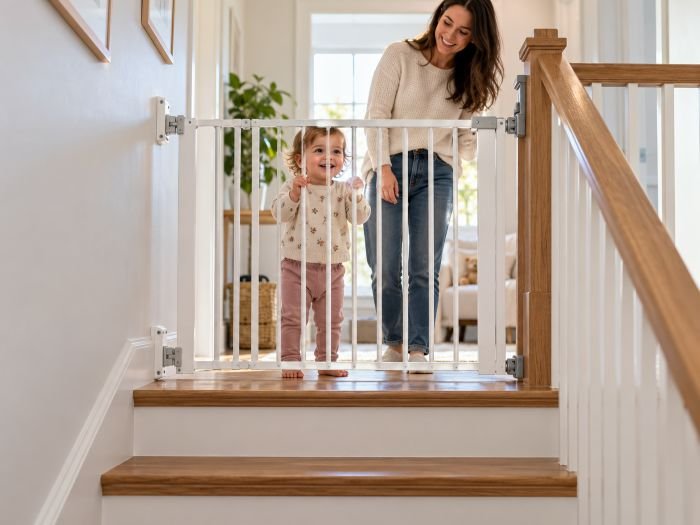
Unlike gates used between rooms or at the bottom of a staircase, a top-of-stairs gate needs to be particularly secure. After all, there’s no room for a gate to slip, fall, or swing open in the wrong direction.
So, how do you know which baby gate is right for your home?
In this guide, we’ll explore the safest baby gate types for stairways, the features to look for, and some common installation mistakes to avoid. We’ll also share practical tips to help you choose a gate that fits your staircase and makes everyday life a little easier.
Disclosure: As an Amazon Associate, I earn from qualifying purchases. This means I may receive a small commission when you purchase through links in this article, at no additional cost to you.
Why Baby Gates for the Top of the Stairs Need Extra Safety Features
Once babies begin crawling, pulling themselves up, and taking their first wobbly steps, stairs become particularly tempting. Unfortunately, they don’t yet understand the dangers of steep steps or sudden drops.
That’s why a properly installed safety gate is crucial.
However, there’s a significant difference between preventing a baby from entering another room and preventing them from falling down a flight of stairs.
At the top of a staircase, a baby might lean against the gate, pull themselves up on the bars, or push against it with their entire body weight.
If the gate becomes dislodged, the consequences can be serious.
For this reason, child safety experts recommend using hardware-mounted baby gates at the top of the stairs. These attach securely to suitable structural supports rather than relying on pressure to stay in place.
Additionally, a gate at the top of the stairs should never swing outward over the staircase. Instead, it should open toward the landing, where adults can safely operate it without stepping backward onto the stairs.
The good news? Once you understand these essential safety features, choosing an appropriate gate becomes much easier.
What Type of Baby Gate Is Safest for the Top of the Stairs?
There are several types of baby gates available, but for stair safety, one type stands out.
Hardware-Mounted Baby Gates for the Top of the Stairs
Hardware-mounted baby gates are the recommended choice for the top of a staircase.
These gates attach to appropriate walls, door frames, or solid structural supports using screws and mounting brackets.
As a result, they provide a more secure installation than gates that rely solely on pressure to stay in place.
Most hardware-mounted stair gates feature a hinged door that adults can open while keeping the gate firmly attached to its mounting points.
When choosing one, look for a model manufacturer-approved specifically for top-of-stairs installation.
Ideally, it should have:
- Secure mounting hardware designed for the installation surface.
- A child-resistant locking mechanism.
- A one-way swing-stop feature that prevents the gate from opening over the stairs.
- No raised bottom threshold or trip bar across the walking path.
- A design without footholds that encourage climbing.
Although hardware-mounted gates require more installation work, the extra security is especially important when there’s a staircase on the other side.
Are Pressure-Mounted Baby Gates Safe at the Top of the Stairs?
It’s easy to see why pressure-mounted baby gates are popular. They’re often quick to install, require little equipment, and can be convenient for separating rooms.
However, you should never use pressure-mounted baby gates at the top of the stairs.
Unlike hardware-mounted gates, pressure-mounted models remain in place through tension against the surrounding walls or door frame.
Consequently, applying too much force may cause the gate to shift or come loose.
Many pressure-mounted gates also have a bottom bar that stretches across the doorway. This creates an additional tripping hazard, particularly when someone is carrying a baby or laundry near the staircase.
Even if a pressure-mounted gate comes with wall cups that can be screwed into place, that does not make it an appropriate substitute for a dedicated hardware-mounted stair gate.
Instead, use pressure-mounted gates only in locations approved by their manufacturer, such as suitable doorways between rooms.
Although pressure-mounted gates work well in suitable doorways and hallways, they aren’t safe for the top of the stairs. If you’re unsure where to use them, read our complete guide to pressure-mounted baby gates to understand their benefits, limitations, and installation requirements.
What About Retractable Baby Gates?
Retractable baby gates appeal to many parents because they’re discreet, take up less space, and can roll away when not needed.
Nevertheless, they should not be your default choice for the top of a staircase.
Flexible retractable barriers may not provide the same rigid protection as a securely mounted swing gate. Therefore, for this high-risk location, choose a rigid hardware-mounted gate specifically designed for the top of stairs rather than a retractable alternative.
7 Features to Look for in Baby Gates for the Top of the Stairs
Not all hardware-mounted gates are created equal. Before buying, consider these seven important features.
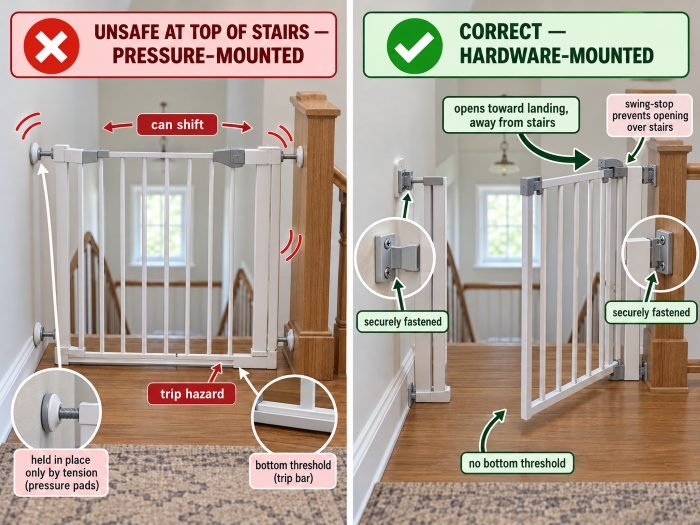
1. Secure Hardware Installation
First and foremost, the gate must attach securely to a suitable support.
Look for strong brackets, appropriate screws, and clear manufacturer instructions.
If your staircase has a wooden banister or an unusual wall arrangement, you may need a compatible mounting kit.
However, avoid improvising with ordinary adhesive pads, unsuitable clamps, or unsupported mounting surfaces.
A gate is only as secure as the structure holding it in place.
2. No Bottom Threshold or Trip Bar
One of the most important features of baby gates for the top of the stairs is a clear walking path.
Some gates have a horizontal metal bar across the bottom. Although this may seem harmless in a doorway, it creates a dangerous obstacle near the stairs.
Instead, choose a gate without a raised bottom threshold.
This makes passing through the gate easier and reduces the chance of catching your foot as you approach the staircase.
3. A Gate That Opens Away From the Stairs
Imagine carrying your sleeping baby upstairs and needing to open the safety gate.
You certainly don’t want to step backward toward the staircase while operating the latch.
For this reason, top-of-stairs baby gates must open onto the landing, never out over the steps.
Look for a gate with a reliable swing-stop mechanism that physically prevents it from opening in the wrong direction.
This is especially useful in busy households where several family members use the stairs throughout the day.
4. A Child-Resistant Locking Mechanism
As babies grow into toddlers, their curiosity and determination grow too!
A latch that seems complicated to a baby today might become an interesting puzzle tomorrow.
Therefore, look for a locking mechanism that requires deliberate adult action.
For example, some gates use a two-step release, such as pressing and lifting simultaneously.
At the same time, the latch should be easy enough for adults to operate correctly every time.
After all, a gate that’s frustrating to use may tempt someone to leave it open.
5. The Right Width for Your Staircase
Before choosing a gate, carefully measure the opening where you want to install it.
Remember that the width between your walls or banisters may differ at the top and bottom of the mounting area.
Also, consider baseboards, decorative trim, and uneven surfaces that could affect the installation.
Some manufacturers offer extensions or adjustable hardware to accommodate different openings.
However, only use extensions and mounting accessories explicitly approved for the gate model.
6. A Design That Discourages Climbing
Your baby’s first attempts to stand may involve grabbing whatever is nearby, including the baby gate.
For this reason, select a gate with smooth vertical bars or another design that doesn’t provide easy footholds.
Avoid decorative horizontal bars or openings that could help toddlers climb.
Additionally, keep furniture, large toys, and storage baskets away from the gate.
Otherwise, a determined toddler may use them as a stepping stone.
7. Compliance With Current Safety Standards
Finally, check whether the gate meets applicable child safety standards.
For products sold in the United States, look for compliance with the current mandatory safety standard for children’s gates and enclosures, which incorporates applicable ASTM F1004 requirements.
You can also look for independent certification, such as the JPMA certification program, where applicable.
However, remember that meeting a safety standard does not automatically make every gate appropriate for the top of the stairs.
The manufacturer must also specifically approve.
stalling a baby gate between two banisters can be more complicated, particularly if the posts are rounded, decorative, or uneven.
Before purchasing, check whether the manufacturer offers a compatible mounting solution for your exact configuration.
If neither side provides a safe attachment point, consider professional installation or an alternative gate location that the manufacturer approves.
Extra-Wide Staircases
Wide staircase openings may require a specially designed hardware-mounted gate.
Although with some models you can buy extension panels, you should never combine extensions from different manufacturers or exceed the approved opening width.
In addition, make sure the gate remains stable across the entire span.
For wider openings, a model specifically designed for that width is often a more practical choice.
How to Install a Baby Gate at the Top of the Stairs Safely
Even the best baby gate won’t protect your child if it’s installed incorrectly.
Thankfully, careful planning and following the manufacturer’s instructions can help prevent common problems.
Here’s what to keep in mind.
Step 1: Measure the Opening
Begin by measuring the width of your staircase opening at the intended mounting points.
Also, identify any baseboards, railings, or uneven surfaces that could interfere with the gate.
Compare your measurements with the manufacturer’s approved installation range.
Step 2: Identify Suitable Mounting Points
Next, locate solid structural supports such as wall studs or suitable solid wood.
Drywall alone may not provide adequate support for the gate hardware.
If you’re working with a banister, use only an approved mounting solution suitable for its shape and construction.
Step 3: Position the Gate Correctly
Install the gate in the manufacturer-approved position at the top of the staircase.
Make sure it opens toward the landing and that the swing-stop mechanism prevents it from opening over the steps.
Also, check that there are no hazardous gaps beneath or beside the gate.
Follow the manufacturer’s instructions for the permitted floor clearance and mounting height.
Step 4: Attach the Hardware Securely
Using the supplied or specified hardware, attach the mounting brackets according to the manufacturer’s directions.
Avoid substituting shorter screws, incompatible anchors, or improvised fittings.
If you’re uncertain whether the wall or banister can support the installation, ask a qualified professional for assistance.
Step 5: Check the Locking Mechanism
Once installed, open and close the gate several times.
Make sure the latch engages fully and that the gate doesn’t swing toward the staircase.
Also, check that all hinges, brackets, and mounting points remain secure.
Step 6: Inspect the Gate Regularly
Installation isn’t something you should forget about once the gate is in place.
Instead, inspect the mounting hardware and latch regularly.
Over time, repeated opening and closing may reveal loose fittings, worn components, or damage.
If you notice anything unusual, stop using the gate until the problem has been corrected according to the manufacturer’s instructions.
Common Mistakes to Avoid With Baby Gates for the Top of the Stairs
Even well-meaning parents sometimes overlook small details that can compromise stair safety.
Here are some of the most common mistakes.
Using a pressure-mounted gate at the top of the stairs. This is one of the most serious mistakes to avoid. Pressure-mounted gates are not secure enough for this location, even when fitted with screw-in wall cups.
Choosing a gate with a bottom trip bar. A raised threshold can catch your foot just as you’re approaching the steps.
Allowing the gate to swing over the staircase. Instead, the gate should open only toward the landing, with a physical stop preventing the opposite direction.
Installing the gate without following the instructions. Incorrect brackets, screws, or mounting locations can weaken the installation.
Leaving the gate open for convenience. Even a brief moment can be enough for a curious baby to reach the stairs.
Stepping or climbing over the gate. This can lead to falls, and older babies may eventually try to copy what they see.
Keeping the gate after your toddler starts climbing it. A gate is no longer providing the intended protection if your child can climb over or operate it. Reassess the entire stair-safety setup immediately.
When Should You Install Baby Gates for the Top of the Stairs?
Many parents wait until their baby starts crawling before thinking about stair gates.
However, it’s better to prepare a little earlier.
Babies develop at different speeds, and those first attempts at moving can happen surprisingly quickly.
Ideally, install safety gates at both the top and bottom of your staircase before your baby becomes mobile, often before six months of age.
That way, you’ll have time to choose the right gate, complete the installation, and make sure everything works correctly.
When Should You Remove Baby Gates?
Baby gates are generally designed for young children, often between six and 24 months, depending on the product and the child’s development.
However, age alone shouldn’t determine when to remove a gate.
If your toddler can climb over it, open the latch, or has exceeded the manufacturer’s height or weight limits, the gate may create new hazards.
At that point, reassess the situation and consider other ways to restrict access to the staircase, such as a suitable locked door separating the child from the stairs.
Meanwhile, continue teaching your child how to use stairs safely under close adult supervision.
Frequently Asked Questions About Baby Gates for the Top of the Stairs
Choosing the right baby gate isn’t always straightforward, especially if your staircase has unusual railings, limited space, or awkward corners. Here are answers to some of the most common questions parents ask about installing and using baby gates for the top of the stairs.
1. Can I Use a Pressure-Mounted Baby Gate at the Top of the Stairs?
No. Pressure-mounted baby gates aren’t recommended for the top of the stairs because they rely on tension rather than a secure structural attachment. Consequently, a child pushing, pulling, or leaning against the gate could cause it to become dislodged.
Many pressure-mounted gates also have a raised bottom bar that creates a tripping hazard near the staircase.
Instead, choose a hardware-mounted baby gate specifically approved for top-of-stairs installation.
2. How Can I Install a Baby Gate on a Banister Without Drilling?
If you have a beautiful wooden banister, it’s understandable that you might hesitate to drill holes into it.
Fortunately, some manufacturers offer banister mounting kits designed to attach a hardware-mounted baby gate securely without drilling directly into the banister.
However, not every mounting kit works with every gate or banister shape. Before purchasing, check that the kit is compatible with your particular gate and that the manufacturer approves the complete installation for the top of the stairs.
Avoid relying on adhesive strips, improvised clamps, or cable ties as substitutes for approved mounting hardware.
3. What If My Staircase Has Uneven Walls or Angled Banisters?
An awkward staircase can make finding the right baby gate frustrating. Perhaps one wall is farther back than the other, or the banister doesn’t line up with the opposite wall.
In this situation, look for a hardware-mounted stair gate specifically designed to accommodate angled installations.
Some models offer adjustable mounting brackets that allow the gate to fit between surfaces that aren’t perfectly parallel.
Nevertheless, never force a standard gate to fit an unsuitable opening. If you cannot achieve a secure installation that follows the manufacturer’s instructions, consult a child-proofing expert.
4. Are Retractable Baby Gates Safe for the Top of the Stairs?
Retractable gates are convenient because they roll away when not in use and usually don’t have a raised bottom threshold.
However, not all retractable baby gates are suitable for the top of the stairs.
Some models are specifically approved for this location, while others are intended only for doorways, hallways, or the bottom of stairs.
For this reason, always check the manufacturer’s instructions, safety certification, required setback from the stairs, and installation requirements.
A rigid, hardware-mounted swing gate designed for stair-top use is generally the simpler choice for this high-risk area.
5. Can I Install a Baby Gate at the Top of the Stairs in a Rental Property?
Yes, but you’ll need to find an installation method that’s both safe and permitted under your rental agreement.
Although pressure-mounted gates may seem attractive because they don’t leave holes, they aren’t appropriate for the top of the stairs.
Instead, ask your landlord whether you can install a hardware-mounted gate using suitable structural supports.
You may also be able to use a manufacturer-approved banister mounting kit to avoid drilling into the banister itself.
Your child’s safety should remain the priority, so don’t compromise by installing a gate that isn’t designed for stair-top use.
6. What If There Isn’t Enough Space on My Landing for a Baby Gate?
Small landings can make baby gate installation particularly challenging.
First, measure the available space carefully and check the manufacturer’s required mounting position and clearance.
A gate that swings toward the landing may need room to open fully without hitting a wall, door, or other obstruction.
If there isn’t enough space, consider another approved gate design or location that blocks access to the entire staircase.
However, don’t install the gate partway down the stairs to make it fit unless the manufacturer explicitly approves that configuration. Doing so could leave exposed steps and create a new fall hazard.
7. Should I Choose an Auto-Close Baby Gate or One That Locks Manually?
Both types can be convenient, but the most important feature is a reliable, child-resistant locking mechanism.
Auto-close gates can be helpful in busy households because the gate closes automatically. However, some require a certain opening angle or closing force to engage the latch properly.
Similarly, manual-lock gates can work well as long as adults remember to close and secure them after every use.
Whichever design you choose, make sure it’s approved for the top of the stairs. Always check that the latch has fully engaged rather than assuming the gate is locked.
9. Can I Install a Baby Gate One or Two Steps Down From the Top?
Installing a gate partway down the staircase may seem like a practical solution when the walls or banisters don’t line up.
However, this can leave one or more steps accessible to your child, creating an additional fall hazard.
Instead, look for a gate designed for your staircase configuration or consider blocking access to the staircase from a suitable hallway or doorway.
Any alternative location should follow the gate manufacturer’s instructions and prevent your child from accessing exposed steps.
10. What Should I Do If My Toddler Shakes or Climbs the Baby Gate?
It’s perfectly normal for curious toddlers to test boundaries, and your baby gate may become one of their favorite things to explore.
However, if your child repeatedly shakes, pulls, or tries to climb the gate, it’s time to reassess the setup.
First, check that all mounting brackets remain secure and that the gate has no loose or damaged parts.
Next, remove nearby furniture, toys, or other objects your toddler could use as a step.
If your child can climb over the gate, open it, or has exceeded its height or developmental limits, stop relying on it as a protective barrier. Consider another safe way to restrict access to the stairs.
11. What If My Baby Gate Doesn’t Latch Properly?
A gate that doesn’t latch securely should never be used at the top of the stairs.
Sometimes, improper latching results from incorrect alignment, loose mounting hardware, or an installation that doesn’t match the manufacturer’s instructions.
However, damaged or defective locking mechanisms can also cause problems.
Inspect the gate and follow the manufacturer’s troubleshooting instructions. If the latch still doesn’t work correctly, contact the manufacturer or replace the gate.
Never assume a gate is safe simply because it appears to be closed.
12. Can I Use a Baby Gate at the Top of the Stairs If I Have a Large Dog?
Yes, but the gate must be designed to protect children and installed according to its instructions.
Large dogs may jump against gates or lean on them, placing additional stress on the mounting points.
Therefore, check the gate’s condition regularly and avoid allowing pets to push or jump against it.
Also, remember that pet gates aren’t necessarily designed or tested for child safety. Always choose a proper child safety gate for areas your baby can access.
13. How Can I Tell Whether a Baby Gate Is Safe Before Buying It Online?
Start by checking whether the manufacturer specifically approves the gate for top-of-stairs installation.
Next, confirm that the gate meets applicable safety standards and includes appropriate mounting hardware and installation instructions.
Read customer reviews carefully, paying particular attention to repeated complaints about loose brackets, difficult latches, poor alignment, and installation problems.
However, don’t rely on star ratings alone. A gate may work perfectly in someone’s kitchen doorway while being completely unsuitable for your staircase.
Finally, check for product recalls, especially when buying from third-party online sellers.
14. Do I Need a Baby Gate at Both the Top and Bottom of the Stairs?
Yes. Installing gates at both ends of a staircase helps protect mobile babies and young toddlers from different hazards.
A gate at the top helps prevent a child from falling down the stairs. Meanwhile, a gate at the bottom prevents them from climbing upstairs without supervision.
The top gate should be a hardware-mounted model approved for that location. At the bottom, you may have additional options depending on the staircase layout and the manufacturer’s instructions.
Once you’ve secured your staircase, consider the other areas your baby might explore. For example, our guide to baby-proofing kitchen cabinets explains how to keep curious little hands away from potentially dangerous household items.
Final Thoughts: Choosing the Safest Baby Gate for Your Staircase
Your baby’s growing independence is something to celebrate. Still, those adventurous little steps mean it’s time to make sure your staircase is properly protected.
When choosing baby gates for the top of the stairs, remember that security matters far more than appearance or convenience.
A sturdy, hardware-mounted gate with no bottom trip bar, a reliable locking mechanism, and a swing-stop feature that prevents opening over the stairs is a good place to start.
Equally important, measure your staircase, choose a model approved for your particular layout, and install it exactly as the manufacturer recommends.
Remember, even the safest baby gate is never a substitute for adult supervision.
With a little preparation and the right safety equipment, you can create a home where your little explorer has plenty of opportunities to discover the world—without the staircase becoming their next adventure.