How to Baby-Proof Kitchen Cabinets: A Stress-Free Guide for Parents
One day, your baby is sitting happily on the kitchen floor, playing with a wooden spoon. The next, they discover how to open the cupboard beneath the sink, and suddenly the entire kitchen becomes their personal playground! Suddenly, learning how to baby-proof kitchen cabinets is no longer something you can put off—it becomes an immediate, urgent priority to keep your curious explorer out of harm’s way.
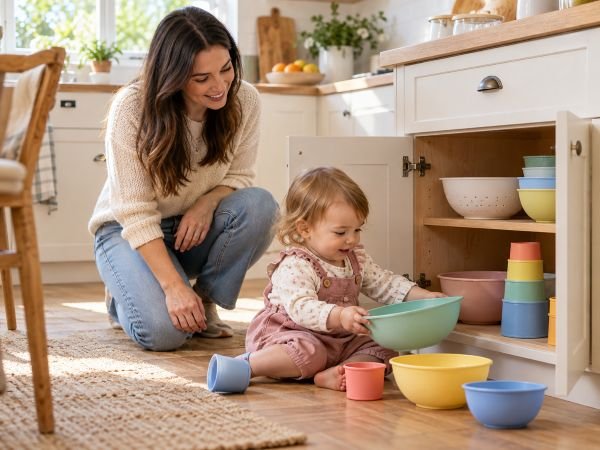
Babies and toddlers love kitchen cabinets. They see us opening doors, pulling out drawers, and reaching for all sorts of interesting objects throughout the day. Naturally, they want to do the same.
Unfortunately, what fascinates a toddler isn’t always safe.
Cleaning products, sharp utensils, glass containers, plastic bags, and small household items can all become dangerous when they’re within reach of their little hands.
Learning how to baby proof kitchen cabinets is one of the simplest ways to make your kitchen safer without turning your entire home upside down.
And the good news? You don’t necessarily need to drill holes into every cupboard or spend a fortune on complicated safety equipment.
In this guide, we’ll look at the best ways to secure kitchen cabinets, the different types of childproof locks available, and how to choose a solution that works for your home and your family.
Disclosure: As an Amazon Associate, I earn from qualifying purchases. This means I may receive a small commission when you buy through links in this article, at no additional cost to you.
Why Baby-Proofing Kitchen Cabinets Is So Important
Kitchen cabinets may seem harmless until you start looking at them from your baby’s perspective.
The cupboard beneath the sink is particularly concerning. Many families store dishwasher tablets, cleaning sprays, bleach, and other household chemicals there.
Even products with child-resistant packaging can be dangerous if a toddler manages to access them.
According to the U.S. Consumer Product Safety Commission (CPSC), safety latches and locks can help prevent children from gaining access to potentially dangerous items, including cleaning products, medicines, matches, and sharp objects.
However, cabinet locks are only one layer of protection. Hazardous products should be stored in their original containers, securely locked away, and out of children’s sight and reach.
When Should You Start Baby-proofing Your Kitchen?
Ideally, before your baby starts crawling.
Some babies become mobile earlier than expected, and you may be surprised by how quickly they learn to pull themselves up, reach for handles, and open drawers.
Don’t wait until you catch your toddler investigating the cleaning supplies.
A little preparation now can prevent a frightening situation later.
What Is the Best Way to Baby-Proof Kitchen Cabinets?
The easiest solution is to install child-resistant cabinet locks or latches that prevent young children from opening cupboard doors independently.
There are several types available, each with its own advantages.
Here’s a quick comparison to help you decide which one is right for your kitchen.
Best Baby proof Cabinet Locks: Quick Comparison
| Type of Cabinet Lock | Best For | Drilling Required? |
|---|---|---|
| Magnetic cabinet locks | Hidden, discreet protection | Not with adhesive models |
| Adhesive cabinet latches | Renters and easy installation | No |
| Sliding cabinet locks | Double-door cabinets with suitable handles | No |
| Screw-mounted cabinet latches | A more permanent fitting | Yes |
| Multi-purpose safety straps | Awkward cabinets and certain appliances | Usually not |
For most everyday kitchens, adhesive magnetic locks are a convenient starting point. However, the best option depends on your cupboard design, the items you’re storing, and how securely you can install these locks
4 Baby-Proof Cabinet Locks Worth Considering
1. Safety 1st Secure-to-Explore Adhesive Magnetic Locks – Best Overall
If you’d rather not have plastic safety straps covering the front of every kitchen cupboard, magnetic locks are worth considering.
One of the biggest advantages of the Safety 1st Secure-to-Explore Adhesive Magnetic Locks is that they’re installed inside the cabinet, so they remain hidden from view.
To open the cupboard, you hold the supplied magnetic key against the outside of the cabinet in the correct position.
It’s a practical solution for keeping little hands out of selected cupboards while maintaining the appearance of your kitchen.
These locks are also particularly appealing if you’re living in rented accommodation or simply don’t want to drill holes into your cabinetry.
Key features:
- Adhesive installation without drilling.
- Locks are concealed inside cabinets and drawers.
- Magnetic key allows adults to unlock the cabinet.
- Lock-status indicators.
- Available in multi-packs.
- Suitable for many cabinet and drawer designs.
What I like: The discreet appearance. You can baby-proof several cupboards without making the kitchen look covered in safety gadgets.
Something to consider: Keep magnetic keys somewhere secure and out of your toddler’s reach. Always test the adhesive and lock mechanism after installation, and check cabinet compatibility before purchasing.
For cupboards containing hazardous products, don’t rely on an adhesive latch as the only protective measure.
Best for: Parents who want discreet cabinet protection without drilling.
Check Safety 1st Magnetic Cabinet Locks on Amazon
2. Adhesive Refrigerator Lock – Best for Keeping Curious Toddlers Out of the Fridge
Once toddlers discover how to open the refrigerator, you may find yourself dealing with a completely new kind of kitchen adventure.
From pulling out milk cartons and dropping eggs to helping themselves to foods they shouldn’t be eating unsupervised, an accessible refrigerator can quickly become another area of concern.
An adhesive refrigerator lock is a simple way to help prevent little hands from opening the fridge whenever curiosity strikes.
The model linked below uses an adhesive attachment system, making it a convenient option for parents who prefer not to drill holes into their appliances.
It’s particularly useful for families with toddlers who have recently learned how to pull open refrigerator or freezer doors.

Key features:
- Adhesive installation without drilling.
- Designed to help restrict young children’s access to refrigerator doors.
- External locking design.
- Can be used with compatible refrigerator and freezer configurations.
- No permanent modification required for installation.
What I like: It’s a simple baby-proofing accessory parents might not think about until their toddler discovers the refrigerator! It adds another practical layer of protection without the need for permanent alterations to an expensive appliance.
Something to consider: Check compatibility with your refrigerator before purchasing, particularly if you have a French-door or side-by-side model. Follow the manufacturer’s installation instructions and wait for the adhesive to set before use.
Remember that refrigerator locks are child-resistant devices, not guarantees of safety. Never use a lock that could prevent someone from opening the refrigerator from the inside, and keep hazardous items securely stored.
Best for: Families with curious toddlers who have discovered how to open refrigerator or freezer doors.
Check the Adhesive Refrigerator Lock on Amazon
3. Safety 1st Double Door Cabinet Lock – Best for Cupboards with Two Handles
If your kitchen has traditional double-door cupboards with two adjacent knobs or handles, a sliding cabinet lock may be one of the easiest options.
Instead of attaching anything inside the cupboard, these locks fit around compatible handles, which prevents the doors from opening independently.
The Safety 1st Double Door Cabinet Lock is designed for this setup and doesn’t require drilling or adhesive.
Because it sits on the outside of the cupboard, you can immediately see whether the lock is in place.
Key features:
- Designed for compatible double-door cabinets.
- No drilling or adhesive installation.
- Removable design.
- Child-resistant locking mechanism.
- Visible placement makes it easy to check whether the cupboard is secured.
What I like: Its simplicity. For cabinets with the right handle configuration, it’s a convenient way to add a barrier without modifying the furniture.
Something to consider: These locks won’t work on every cupboard. If you have handleless cabinets, widely spaced handles, or unusual knobs, you’ll need another option.
Also, remember to replace the lock every time you open the cupboard.
Best for: Traditional double-door kitchen cabinets with adjacent handles.
Check Safety 1st Double Door Cabinet Locks on Amazon
4. Safety 1st Cabinet & Drawer Latches – Best Traditional Option
Sometimes the simplest solutions are still worth considering.
Traditional cabinet latches have been used for years to help restrict children’s access to cupboards and drawers.
The Safety 1st Cabinet & Drawer Latches are fitted inside the cabinet. When installed correctly, the latch catches as you open the cupboard, preventing the door from opening fully until an adult releases it.
They’re unobtrusive and useful for several everyday storage areas.
Key features:
- Internal mounting.
- Designed for cabinets and drawers.
- Traditional catch-and-release mechanism.
- Available in multi-packs.
- No magnetic key to keep an eye on.
What I like: They’re a straightforward alternative to magnetic systems, particularly for families who prefer a permanent, screw-mounted solution.
Something to consider: The cabinet door may open slightly before the latch catches. Prevent access to hazardous materials through the gap, and keep all sharp objects, medications, and chemicals out of reach.
Best for: Parents wanting a traditional internal latch system for compatible cabinetry.
Check Safety 1st Cabinet and Drawer Latches on Amazon
How to Baby-Proof Kitchen Cabinets Without Drilling
A common concern for parents is whether they can baby-proof their kitchens without damaging the furniture.
Thankfully, there are several options.
Adhesive magnetic locks are especially useful because they fit inside the cupboard, leaving the exterior unchanged.
Adhesive latches are another option, while sliding locks are suitable for double-door cabinets with compatible handles.
Whichever type you choose, installation matters.
How to Install Adhesive Cabinet Locks Correctly
Follow the instructions supplied with your specific product, but these general steps will help you prepare:
- Clean the surface. Remove grease, moisture, and dust from the intended mounting area using a manufacturer-approved cleaning method.
- Check the cabinet material. Some adhesives may not bond correctly to textured, unfinished, or unsuitable surfaces.
- Position the lock carefully. Test the alignment before removing the adhesive backing.
- Press the components firmly into place. Follow the manufacturer’s recommendations for pressure and positioning.
- Allow the adhesive to cure. Some products require 24 hours before you can use them reliably.
- Test the mechanism. Once the adhesive has cured, check that the lock engages properly and remains secure when you pull the door.
One additional point for renters: No-drill doesn’t always mean damage-free. Adhesive can occasionally affect painted, laminated, or delicate finishes during removal.
It’s worth checking this before installation.
Which Kitchen Cabinets Should You Baby-proof First?
You don’t necessarily need to lock every single cupboard in your kitchen.
Instead, start with the areas that present the greatest risks.
1. The Cabinet Under the Kitchen Sink
This is probably the first area I would address.
Move cleaning sprays, dishwasher detergent, bleach, drain cleaners, and similar products to a suitable locked storage area, ideally high up and completely out of children’s sight and reach.
If you continue using the cupboard beneath the sink for household supplies, don’t assume a basic adhesive child latch makes storage of dangerous chemicals safe.
2. Cabinets Containing Knives and Sharp Objects
Store knives, scissors, graters, peelers, and other sharp kitchen tools securely so your toddler cannot access them.
Use a suitable locking drawer or dedicated locked storage area positioned out of reach.
3. Drawers Containing Small Objects
Kitchen drawers often contain things we don’t immediately recognize as potential hazards.
Bottle caps, batteries, plastic bags, skewers, clips, and other small items can be dangerous when placed in a young child’s mouth.
Go through your drawers carefully and remove anything that could create a choking or injury risk.
4. Cabinets Containing Heavy or Breakable Items
Large serving dishes, ceramic bowls, glass containers, and heavy cookware can injure a toddler if they pull them from a cupboard.
Move heavier or breakable items to more secure storage, and ensure you protect any accessible cabinets appropriately.
5. The Kitchen Trash Cabinet
Your kitchen bin may contain sharp food packaging, spoiled food, discarded batteries, or other potentially dangerous objects.
If a pull-out cabinet stores a bin, consider a compatible locking mechanism.
Freestanding bins should also have secure lids and be positioned where young children cannot access their contents.
Should You Leave One Kitchen Cabinet Unlocked for Your Baby?
Here’s a smart parenting idea I particularly like: Instead of turning every kitchen cupboard into a forbidden mystery, why not create one designated baby-friendly cupboard.
Toddlers are naturally curious, and giving them something safe to investigate can offer a fun way to explore their surroundings.
Choose a low cupboard away from the stove and other hazards, and fill it with a few age-appropriate items.
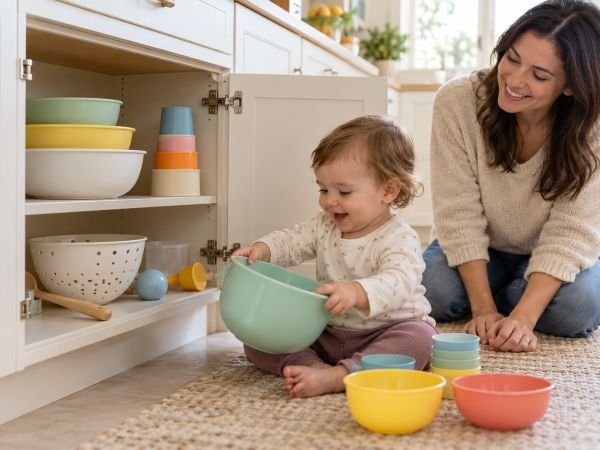
For example:
- Large, lightweight plastic bowls.
- Suitable baby-safe stacking cups.
- Large, smooth, age-appropriate play utensils.
- Lightweight containers without detachable small parts.
Avoid plastic bags, breakable dishes, heavy pans, small lids, and anything with loose components.
Make sure the cupboard itself is stable, free of sharp or damaged fittings, and doesn’t provide access to neighboring cabinets or hazards.
Of course, this is an activity for supervised play, not a place to leave your baby unattended.
A small cupboard filled with safe treasures can make your toddler feel wonderfully included while you’re spending time together in the kitchen.
6 Common Baby-proofing Mistakes to Avoid
Even with the right products, small oversights can leave parts of your kitchen less secure than you think.
1. Assuming a child-resistant lock is completely childproof.
No safety device guarantees to stop a determined toddler. Check locks regularly and always use appropriate storage for dangerous products.
2. Forgetting to lock the cupboard again.
This especially happens when you’re busy preparing dinner. Therefore, make checking cabinet locks part of your kitchen routine
3. Leaving magnetic keys within reach.
Store keys somewhere high and secure, where your toddler cannot access them.
4. Installing adhesive locks on dirty surfaces.
Kitchen cabinets often accumulate grease and moisture. These can interfere with adhesive installation.
5. Overlooking drawers.
Parents sometimes secure every cupboard but forget that drawers may contain knives, scissors, batteries, or other hazards.
6. Forgetting that the kitchen changes as your child grows.
A cabinet your baby couldn’t reach last month might suddenly become accessible when they learn to stand or climb.
Regularly reassess your kitchen from your child’s developing perspective.
What Else Should You Baby-Proof in the Kitchen?
Securing your cabinets is a great start, but it’s only one part of making your kitchen safer.
Other areas worth checking include:
- Stove knobs and controls that a toddler can reach.
- Oven doors and other hot surfaces.
- Electrical cords hanging from counter tops.
- Freestanding ranges that require properly installed anti-tip brackets.
- Dishwasher access, especially when detergent or sharp utensils are present.
- Tablecloths or hanging items that children can pull.
- Small appliances and their power cords.
- Household chemicals stored outside cabinets.
A safety gate installed at the kitchen entrance is useful when the layout allows it. Just make sure it fits the location and doesn’t interfere with a necessary emergency exit.
Related reading: Best Baby Gates for Stairs: Keeping Your Little Explorer Safe
Frequently Asked Questions About Baby-proofing Kitchen Cabinets
What is the easiest way to baby-proof kitchen cabinets?
Adhesive cabinet latches or magnetic locks are convenient options for many families because they don’t require drilling.
However, the easiest solution will depend on your kitchen layout and the type of cabinet doors you have.
Are magnetic cabinet locks safe for babies?
Properly installed, age-appropriate magnetic cabinet locks can help restrict access to kitchen cabinets.
Keep the magnetic key securely out of reach, check the locks regularly, and don’t rely on them as the only protection for hazardous substances.
Can I baby-proof cabinets without handles?
Yes. Internal magnetic locks and suitable adhesive latches can often be fitted to handleless cabinet doors.
Check the manufacturer’s compatibility requirements before purchasing.
How do I stop my toddler from opening kitchen drawers?
Install child-resistant drawer locks made for your specific drawer design. Standard choices range from magnetic locks and adhesive latches to internal mechanical catches.
Secure any drawers with sharp or dangerous items, and store their contents in a securely locked, inaccessible location.
Do I need to baby-proof every kitchen cabinet?
Not necessarily.
Focus on securing cabinets and drawers containing anything that could injure your child. You may choose to leave a carefully prepared cupboard containing only age-appropriate, safe play items accessible during supervised activities.
What if my toddler figures out how to open the cabinet locks?
Stop relying on that lock immediately.
Move dangerous items to a secure, inaccessible location and install a more suitable locking system.
Children develop problem-solving skills quickly, so yesterday’s solution may not always be sufficient tomorrow.
Final Thoughts: Making Your Kitchen Safer, One Cupboard at a Time
Baby-proofing your kitchen doesn’t mean removing every interesting object or turning your home into a space where your little one can’t explore.
It’s about recognizing potential dangers and setting sensible boundaries that allow your child to discover the world more safely.
For most everyday cabinets, I would start by considering the Safety 1st Secure-to-Explore Adhesive Magnetic Locks. They’re discreet, practical, and don’t require drilling, making them particularly convenient for many modern kitchens.
For traditional double-door cupboards, the Safety 1st Double Door Cabinet Lock is another simple option.
And remember that for cleaning products, medicines, and other hazardous items, a child-resistant latch is never a substitute for secure, inaccessible storage.
You don’t have to baby-proof your entire kitchen in one afternoon. Start with the highest-risk areas, choose suitable safety products, and regularly review your setup as your baby grows.
Because that wonderful curiosity deserves a safe place to flourish.
Continue baby-proofing your home: Best Baby Gates for Stairs | How to Baby proof Your Living Room | The Complete Baby-proofing Checklist