How to Baby-proof Your Living Room: The Only Checklist You Need
It’s funny how differently you start looking at your living room once your baby learns to crawl.
Learning how to baby-proof your living room becomes the ultimate way to swap your worries for peace of mind. You don’t have to sacrifice your style to create a secure space; with a few simple, thoughtful adjustments, you can transform your favorite family hangout into a warm and worry-free haven where your little explorer can safely thrive.
Even the smallest things seem to attract the attention of a toddler. A loose cable behind the sofa, a remote control left on the floor, or the tiny gap beneath a cabinet is pure magic for a curious toddler.
Of course, exploring is exactly what babies are supposed to do. It’s how they learn about the world around them.
Our job is to make that exploration as safe as reasonably possible.
The good news is that learning how to baby-proof your living room doesn’t mean getting rid of all your furniture or covering every available surface in plastic.
A few carefully chosen safety products, some changes to your furniture arrangement, and a little attention to easily overlooked hazards can make a meaningful difference.
Let’s go through the room together, starting with the things I would address first.
Disclosure: As an Amazon Associate, I earn from qualifying purchases. This means I may receive a small commission when you purchase through links in this article, at no additional cost to you.
At a Glance: Living Room Baby-proofing Checklist
| Area | What You Need to Do |
|---|---|
| Furniture and TV | Anchor heavy and potentially unstable items |
| Coffee tables | Protect sharp corners and edges |
| Electrical outlets | Install suitable child-resistant protection |
| Electrical cords | Keep cables and power strips inaccessible |
| Windows | Install appropriate guards or stops and use cordless blinds |
| Fireplace | Use a suitable fireplace safety barrier |
| Small objects | Remove choking and ingestion hazards |
| Cabinets and drawers | Secure storage containing hazardous items |
| Play space | Create a clear area for supervised exploration |
| Stairs and doorways | Install appropriate safety gates |
When Should You Start Baby-proofing Your Living Room?
Ideally, before your baby starts crawling.
So don’t wait until they’ve mastered this properly. Some babies become surprisingly mobile through rolling, shuffling, or a rather determined combination of both.
You may have heard this before, but a truly useful exercise is to get down on your hands and knees and take a good look around your living room.
It might feel a little silly, but you’ll quickly notice things that are not clear when you’re standing.
Can you see the electrical cords behind the television? Is there a sharp edge on the coffee table? Could your baby reach the lower shelves of the bookcase?
Check underneath furniture, too. It’s amazing how many little objects manage to collect there.
Once you’ve identified the main hazards, you can start making the room safer.
1. Anchor Heavy Furniture and Your Television
Let’s start with one of the most important safety measures in any family living room.
Heavy furniture needs to be secured.
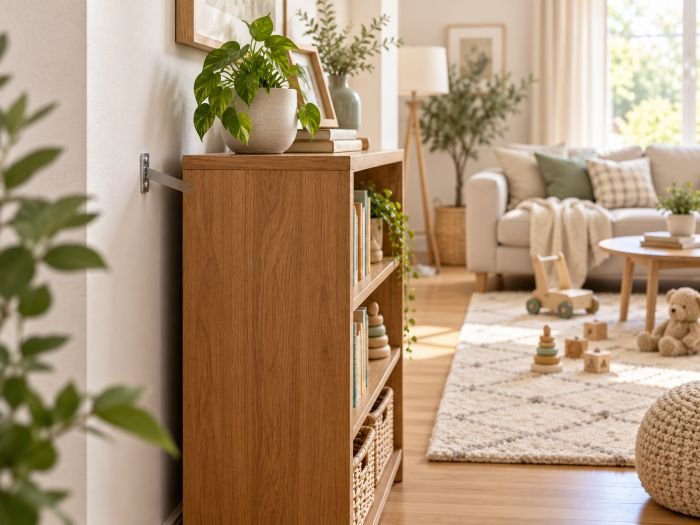
A bookcase or television cabinet may look perfectly stable to an adult, but the situation changes when a toddler starts pulling on drawers or using shelves as climbing steps.
The U.S. Consumer Product Safety Commission (CPSC) warns that unsecured furniture and televisions can tip over and cause serious injuries to children.
And here’s something to remember: A heavy piece of furniture isn’t necessarily a stable one.
What you should do:
- Secure bookcases, storage cabinets, and other potentially unstable furniture.
- Properly mount or anchor your television.
- Use the right anchoring hardware compatible with your furniture and wall construction.
- Keep toys and remote controls off high shelves so children aren’t tempted to climb.
- Follow the manufacturer’s installation instructions.
Moreover, check furniture in other rooms, particularly bedrooms and nurseries.
Product to Consider: Metal Furniture Anti-Tip Anchoring Kit
A suitable metal anti-tip restraint system can help secure compatible furniture to structural mounting points.
Look for restraints that comply with the applicable ASTM F3096 standard, check their suitability for your furniture, and verify that the product hasn’t been recalled.
Find Metal Furniture Anti-Tip Anchors on Amazon
A practical tip: If you’ve recently purchased a dresser or storage cabinet with an anchoring kit, don’t leave that little packet of hardware sitting in a drawer. Install it before your baby starts exploring.
2. Protect Sharp Coffee Table and Furniture Corners
Coffee tables and babies learning to walk aren’t always a happy combination.
Once your little one begins pulling themselves up against furniture, those hard edges are suddenly at exactly the wrong height.
If your living room has a coffee table with sharp corners, a low television cabinet, or other hard-edged furniture, consider adding suitable corner and edge protection.
You don’t necessarily need to cover everything. Concentrate on furniture your baby can realistically reach or fall against.
A Simple Solution: Edge and Corner Protectors
Roving Cove offers cushioned furniture protectors that can help soften accidental contact with hard corners.
They’re particularly useful for certain coffee tables and low cabinets.
Check this Baby Proofing Edge Corner Protector on Amazon
Make sure the protectors are securely attached and inspect them regularly. Once a toddler discovers that something can be peeled off, they can become remarkably persistent!
If a protector comes loose or becomes damaged, remove it immediately.
Also, be realistic about the furniture itself. It is better to remove or replace a glass coffee table or an unstable piece of furniture rather than simply padding it.
3. Make Electrical Outlets Safer
For reasons known only to babies, electrical outlets seem to be far more interesting than the expensive educational toys we buy them.
And unfortunately, many outlets are positioned at exactly the right height for crawling children.
If your home has older-style outlets, consider asking a qualified electrician about tamper-resistant receptacles. These contain an internal mechanism designed to restrict access unless a plug is inserted correctly.
Suitable child-resistant outlet covers can provide additional protection where appropriate.
However, avoid removable plastic outlet plugs that your child could pull out and put in their mouth.
Product to Consider: Safety 1st Sliding Outlet Covers
These covers restrict access to compatible outlets but still allow adults to use them when needed.
Unlike loose plastic plugs, suitable sliding covers remain attached to the outlet plate.
Find Safety 1st OutSmart Outlet Shield
Before purchasing, check compatibility with your electrical outlets. Designs and safety requirements differ between countries.
4. Tidy Up Those Electrical Cords
Take a look behind your television cabinet.
If your home is anything like most family homes, there’s probably a collection of television cables, phone chargers, extension leads, and perhaps a few mystery cords that nobody remembers buying.
Unfortunately, babies tend to find these things fascinating.
Loose cables can create entanglement hazards, while accessible electrical cords, plugs, and power strips present additional risks.
Start by moving cables behind furniture where your baby cannot reach them.
Use suitable cord-management accessories to organize loose wiring, and avoid leaving charging cables dangling from side tables.
Pay particular attention to floor lamps and other electrical items that could be pulled over by their cords.
Product to Consider: D-Line Cable Management Box
A cable management box can help organize certain power strips and electrical connections.
It’s a useful way to reduce visible cable clutter, particularly around television cabinets and computer equipment.
Find Cable Management Boxes on Amazon
One important detail: A cable box isn’t automatically childproof.
Position it somewhere inaccessible, keep the cords entering and leaving the box out of reach, and follow the electrical equipment manufacturer’s ventilation requirements.
Sometimes, simply rearranging your furniture is the most effective solution.
5. Check Your Windows and Blinds
Window safety is easy to overlook, particularly if your baby isn’t walking yet.
But babies grow quickly, and that low chair positioned beneath your living room window may eventually become an excellent climbing opportunity.
There are two separate things to consider here.
Preventing Window Falls
Move sofas, chairs, storage boxes, and other climbable furniture away from windows.
Where appropriate, install suitable window guards or window stops that meet local safety and emergency escape requirements.
Don’t rely on an ordinary insect screen to prevent your child from falling through an open window.
Eliminating Blind Cord Hazards
Traditional window blinds with dangling cords can present a strangulation hazard to babies and young children.
The CPSC recommends using cordless window coverings in homes with young children.
If you have older corded blinds, replacing them with a suitable cordless model is preferable to relying on hooks or improvised cord management.
Amazon product suggestion: Cordless Blackout Roller Blinds
Choose a genuinely cordless model that fits your window correctly and can be installed securely.
Don’t forget to check the blinds in your baby’s bedroom, too.
6. Baby-proof Your Fireplace
A fireplace can make a living room feel wonderfully cozy, especially during the colder months.
But it’s also an area that requires particular attention when you have a baby or toddler.
Even when the fire isn’t lit, there may be sharp stone hearth edges, fireplace tools, loose accessories, or glass panels within reach.
And if you have a wood-burning stove, remember that the glass and surrounding surfaces can remain dangerously hot long after the fire has gone out.
A standard doorway baby gate isn’t necessarily appropriate for this area.
Instead, choose a fireplace safety barrier specifically approved for your type of fireplace or stove.
Product to Consider: KidCo HearthGate
The KidCo HearthGate range is designed for certain fireplace and hearth-barrier applications.
Depending on your layout, a compatible configuration can help keep your child away from the fireplace area.
Check out the KidCo HearthGate on Amazon
Before buying, check the manufacturer’s mounting requirements and minimum heat clearances.
Also remember to:
- Store matches, firelighters, and fireplace tools securely.
- Never attach ordinary foam corner protectors to hot surfaces.
- Keep children away from fireplace glass, even after the fire is extinguished.
- Install and regularly maintain smoke and carbon monoxide alarms.
A fireplace barrier provides an additional layer of protection, but children still need appropriate supervision around fireplaces and stoves.
7. Remove Small Objects and Choking Hazards
Have you ever cleaned underneath your sofa and wondered how half the household ended up there?
Coins, buttons, little pieces from older children’s toys, hair clips, and the occasional mystery object seem to collect in the most unlikely places.
Unfortunately, once your baby starts crawling, they’re often the first to find them.
Anything small enough to fit into a young child’s mouth deserves a closer look.
Pay particular attention to television remotes, battery-operated decorations, and other household accessories with button or coin batteries.
These batteries are especially dangerous if swallowed and require immediate medical attention if ingestion is suspected, even when the child initially appears well.
A useful habit: Before your baby begins playing on the floor, take a quick look underneath nearby furniture and between sofa cushions.
If you have older children, check the floor after they’ve finished playing with toys containing smaller parts.
And remember that decorative items aren’t necessarily designed with babies in mind. Small stones, beads, and ornaments should all be kept inaccessible.
Sometimes the best baby-proofing solution doesn’t cost anything. It’s simply removing an unnecessary hazard.
8. Secure Cabinets and Drawers
Once your baby discovers that drawers open, there’s often no stopping them!
Living room storage can contain all sorts of interesting things: batteries, cables, tools, small electronics, candles, and other items you’d rather your toddler didn’t investigate.
Start by checking what you’re storing in your television unit, sideboards, and coffee table drawers.
Move hazardous items to secure, inaccessible storage.
For everyday cabinets, suitable child-resistant latches can help prevent little hands from opening them independently.
Product to Consider: Safety 1st Secure-to-Explore Magnetic Cabinet Locks
If you prefer not to have visible plastic straps across your furniture, internal magnetic locks offer a more discreet option for compatible cabinets and drawers.
Check Safety 1st Magnetic Cabinet Locks on Amazon
Keep the magnetic key somewhere secure, test the locks after installation, and check them regularly.
Remember that cabinet locks don’t prevent furniture from tipping over. You may still need to anchor storage units.
For more detailed installation advice, read our guide on How to Baby-proof Kitchen Cabinets.
9. Create a Comfortable Space for Your Baby to Play
Now for the enjoyable part!
Once you’ve addressed the main hazards in your living room, it might be worth setting aside a little area just for your baby.
You don’t need a separate playroom or an enormous collection of toys.
In fact, a simple play mat, a few age-appropriate toys, and enough space to roll, crawl, and explore can be a lovely starting point.
Choose a location away from fireplaces, accessible windows, electrical cords, and unstable furniture.
If your living room is open-plan, a suitable child-specific play yard may help create a defined area for supervised activities.
Product to Consider: Toddleroo Superyard Colorplay
The Toddleroo Superyard Colorplay is a configurable plastic play enclosure that can provide a designated space for supervised play.
Its six-panel design makes it a practical option for families who have enough room for an enclosed play area.
Check the Toddleroo Superyard Colorplay on Amazon
Keep the play space simple. A few age-appropriate toys are usually plenty, and you can rotate them occasionally to keep things interesting.
Important: Play-only enclosures and foam play mats are not infant sleep spaces. If your baby falls asleep, move them to an appropriate crib, bassinet, or sleep-approved playard.
For more ideas, see our complete guide: How to Create a Safe Baby Play Area at Home.
10. Baby-Proof Stairs and Doorways in the Living Room
Finally, check where your living room leads.
Is there an open doorway into the kitchen? Does your living room connect directly to a staircase?
Once your baby becomes mobile, these areas may need an appropriate safety gate.
Choose a model designed for the intended location, and always follow its installation instructions.
For the top of stairs, use a properly installed hardware-mounted gate. Never use Pressure-mounted gates in this position.
Product to Consider: KidCo Safeway Top of Stair Gate
The KidCo Safeway is designed specifically for appropriate staircase applications.
Because it screws into the wall and only opens in one direction, this gate is ideal for keeping stairs safe.
Check the KidCo Safeway Baby Gate on Amazon
Measure your opening carefully before purchasing, and check whether your staircase requires additional manufacturer-approved mounting accessories.
For a detailed comparison, read Best Baby Gates for Stairs.
Which Living Room Baby-Proofing Products Should You Buy First?
If you’re beginning from scratch, the list of available baby safety products can feel rather overwhelming.
But you certainly don’t need to purchase everything at once.
My advice is to look at your living room and address the most serious hazards first.
| Your Main Concern | Product to Consider |
|---|---|
| Unsecured bookcase or television | Suitable metal anti-tip restraints |
| Sharp coffee table edges | Roving Cove Corner Protectors |
| Accessible electrical outlets | Compatible sliding outlet covers |
| Exposed cables | D-Line Cable Management Box |
| Corded window blinds | Cordless roller blinds |
| Fireplace or wood-burning stove | Compatible KidCo HearthGate |
| Accessible storage | Safety 1st Magnetic Cabinet Locks |
| Need a designated play area | Toddleroo Superyard Colorplay |
| Staircase access | KidCo Safeway Baby Gate |
You may find that you can avoid some hazards simply by rearranging the room, storing dangerous items elsewhere, or replacing an unsuitable piece of furniture.
A safer living room doesn’t necessarily mean buying more things.
Your Living Room Baby-proofing Checklist
Use this checklist as a final walk-through once you’ve finished making changes.
- Keep screen time safe by securely mounting or anchoring your television to the wall.
- Anchor bookcases and top-heavy furniture so your little adventurer can’t pull them down.
- Soften the bumps of early steps by adding protective guards to sharp furniture corners.
- Keep curious fingers safe by popping protective covers onto your electrical outlets.
- Make charging cables, power strips, and loose cords inaccessible.
- Replace corded window coverings with cordless alternatives.
- Keep curious toddlers safe by installing window guards or safety stops.
- Create a cozy, secure fireside by adding protective guards around the fireplace and hearth.
- Keep curious climbers safe by moving furniture away from all windows.
- Protect little hands and mouths by tucking away small objects and loose batteries.
- Secure storage drawers and cabinets so your toddler can explore safely without pinches or spills.
- Keep play areas clear of clutter and tripping hazards.
- Wrap your home in safety by putting up sturdy gates at staircases and dangerous doorways.
- Enjoy peace of mind by installing and regularly checking your smoke and carbon monoxide alarms.
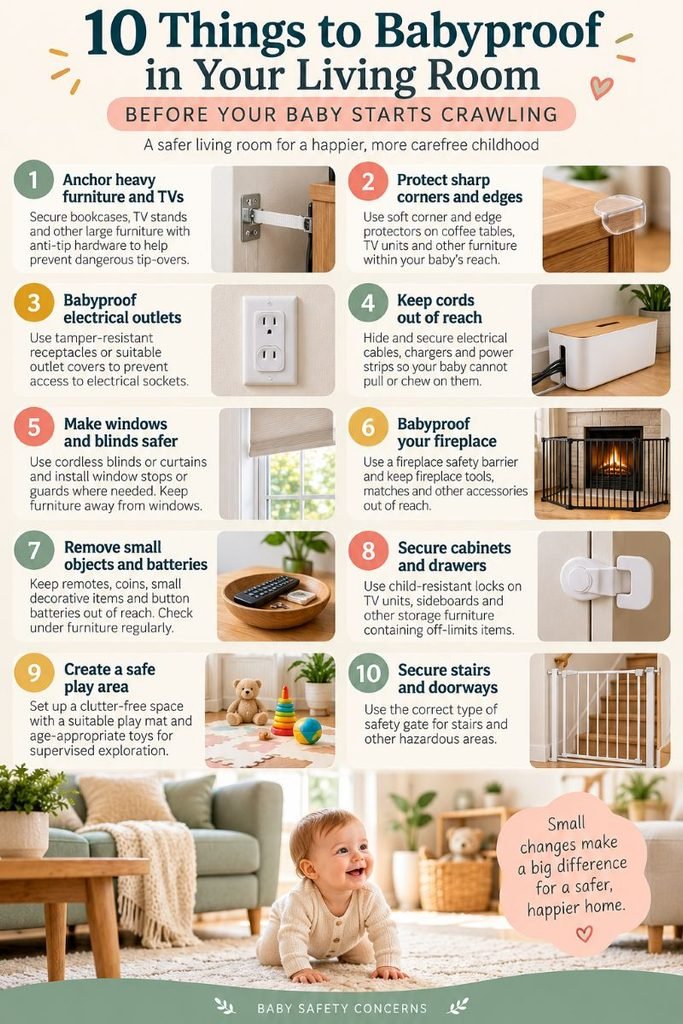
Keep the checklist handy. You’ll want to review it again as your baby learns new skills.
Common Living Room Baby-proofing Mistakes to Avoid
Even after you’ve installed safety products, there are a few things worth remembering.
Don’t assume heavy furniture is too difficult for a toddler to tip over. Secure potentially unstable furniture, even if it appears sturdy.
Don’t rely entirely on corner protectors. They can soften certain bumps, but they won’t make unstable furniture or an unsuitable glass table safe.
Don’t forget the spaces behind furniture. Babies are surprisingly good at squeezing into places we thought were inaccessible.
Don’t overlook window blind cords. Keeping them neatly arranged isn’t the same as eliminating the hazard.
Don’t use a playpen as a substitute for supervision. An enclosed space helps create boundaries, but it doesn’t remove every possible risk.
Most importantly, don’t assume your baby-proofing is finished forever.
A room that seems reasonably safe for a six-month-old may need several adjustments once that same baby starts walking and climbing.
Frequently Asked Questions About Baby-proofing Your Living Room
How do I baby-proof my living room without removing all my furniture?
Start by anchoring heavy furniture, protecting sharp corners, securing electrical hazards, and removing small objects. Keep furniture that can be made reasonably safe, and consider replacing pieces that present hazards you cannot adequately address.
When should I start baby-proofing my living room?
Ideally, before your baby becomes mobile. Preparing during the early months gives you time to identify and address hazards before crawling and pulling up begin.
How do I babyproof a living room with a fireplace?
Choose a fireplace-specific safety barrier suitable for your installation. Follow the manufacturer’s clearance and mounting instructions, and keep fireplace tools, matches, fuel, and other hazardous accessories inaccessible.
Do I really need a baby playpen?
Not necessarily. A thoroughly baby-proofed room can provide a suitable environment for supervised exploration. However, a child-specific play yard may be useful if you want to create a defined area within a larger room.
Are coffee table corner protectors enough?
Corner protectors can help soften some accidental impacts, but they don’t address unstable furniture, breakable glass, or other hazards. Assess the entire piece of furniture before deciding whether it is suitable for a home with young children.
How do I stop my toddler from climbing the television cabinet?
Secure both the television and supporting furniture appropriately. Remove tempting objects from elevated surfaces, make cables inaccessible, and consider changing the furniture arrangement if climbing continues.
What should I baby-proof first in my living room?
Begin with hazards that could cause serious injuries, including unsecured furniture and televisions, accessible electrical cords, unsafe windows, corded blinds, and fireplaces. Once you address these, move on to furniture corners, storage, and creating a suitable play space.
Final Thoughts: How to Baby-Proof the Living Room
Don’t feel you need to babyproof the entire living room in a single afternoon.
Start with the important things, particularly heavy furniture, electrical hazards, windows, and fireplace access. Then work your way through the smaller details.
Once you’ve finished, get down on the floor and take another look around.
Chances are you’ll spot something you missed the first time!
And don’t be surprised if you need to make a few more adjustments in another month or two. Moreover, babies have a remarkable talent for discovering things we thought were safely out of reach.
Your living room can still be a comfortable, welcoming place for the whole family. The goal isn’t to remove every opportunity for exploration, but to make those everyday discoveries a little safer.
Continue Babyproofing Your Home:
- Best Baby Gates for Stairs
- How to Baby-proof Kitchen Cabinets
- How to Create a Safe Baby Play Area at Home
- The Complete Room-by-Room Baby-proofing Checklist
Safety References
For further reading and verification of the safety recommendations in this article: